| In a follow-up to my blog on the Coat of Arms of the illegitimate offspring of British Royals, I am indebted to Jonathan Webster for pointing me in the direction of the Earl of Erroll for the Arms assigned to Elizabeth FitzClarence, daughter of HRH Prince William Henry, Duke of Clarence (later HM King William IV) and Dorothea Jordan. She married William Hay, 18th Earl of Erroll, in 1820. Her Arms were subsequently quartered by her children and remain in the 'Grand' Coat of Arms of the Earls to this day. As Jonathan Webster points out, Elizabeth was assigned the Royal Arms (once her Father came to the Throne in 1830) debruised by a blue Baton Sinister charged with a gold Anchor (her Father's main charge on his own Label when he had been a prince) between two gold Thistles to reflect the fact that the Earldom of Erroll is a title in the Peerage of Scotland. The Earl of Erroll remains one of four peers entitled to appoint a private pursuivant. Erroll's Pursuivant is called "Slains Pursuivant of Arms" and wears a Tabard of white with the three red Shields. Elizabeth died in Edinburgh in 1856. | 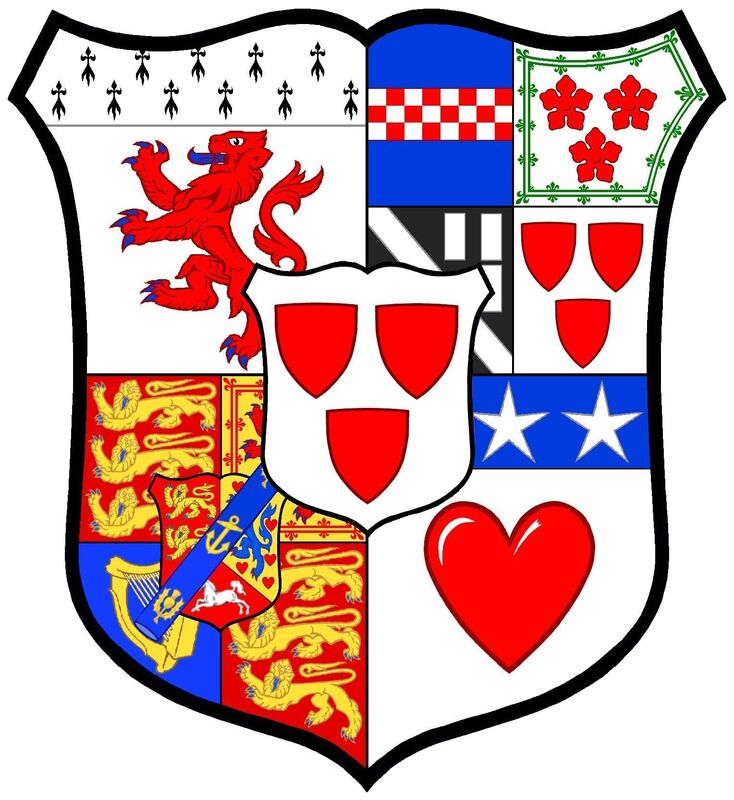 'Grand' Coat of Arms of Rt. Hon. Merlin Hay, The Earl of Erroll, showing the Arms of Elizabeth FitzClarence in the third Quarter. Source: Pinterest/William Howard. (Artist unknown.) (www.pinterest.co.uk/pin/396176098456514782/) |
|
4 Comments
I could hardly believe my eyes when I saw that King Phillipe of the Belgians has revised the Coats of Arms of the Belgian Royal Family with a somewhat backward step. Whether Their Majesties' recent visit to Germany and, specifically, Thuringia, Saxony-Anhalt and Friedenstein Castle, an ancestral castle where the head of the House of Saxe-Coburg-Gotha once lived, has anything to do with it is subject to speculation, of course.
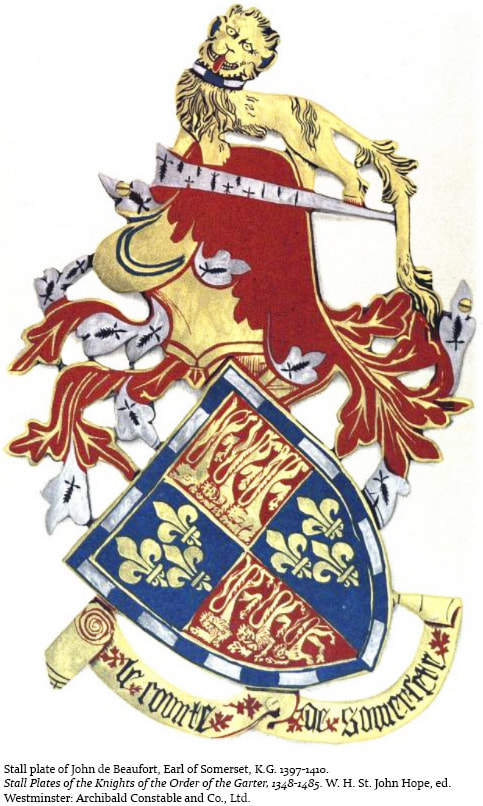
In a decree (http://www.ejustice.just.fgov.be/mopdf/2019/07/19_2.pdf) signed on 12th July 2019 and coming into force a week later on the 19th in time for Belgium's National Day (but not in time for the graphics on the podium) the Arms of the whole Royal Family (including a king or queen who have abdicated) have been changed with Labels and Bordures. However, the biggest change is the return of the In escutcheon of Saxony on the shoulder of the Belgian Lion on the Shield. Why? As with the British Royal Family, the Belgians ceased using the Dynastic name Saxe Coburg and Gotha of the House of Wettin after the First World War for reasons already noted elsewhere in these pages. The Belgian Royal Family took on the surname 'of Belgium' in the various languages of the country (“van België” or “de Belgique” or “von Belgien”). I presume the need is to distinguish the Coats of Arms of the family from the Coat of Arms of the country, especially as the monarch has always been "King (or, in the future, Queen) of the Belgians". But why the Inescutcheon of Saxony? Having said that, a welcome step is the fact that an abdicated King or Queen will now receive a 3 pointed Label to distinguish them from the reigning monarch, especially as there appears to be no requirement for them to revert to Prince or Princess. This Label is red with a Crown at the centre (rather like The Duke of Windsor's Label). Red Labels have been used before, namely for King Albert I before his accession and his his elder brother Baudouin of Flanders who died before he could come to the Throne, and also their Father Phillipe of Flanders. The remaining Princes and Princesses retain the colour yellow (with one exception, which I will cover later). The Duke or Duchess of Brabant, i.e. the heir to the Throne, receives a yellow 3 pointed Label. This position not only retains the general Cadency Mark of what had been the whole of the Royal Family up to now, but is also interestingly now in line with the heirs in the other two Benelux kingdoms (Luxembourg and the Netherlands). This would seem to be in time for Princess Elisabeth's 18th Birthday which is coming up this October when she will be expected to take on fully the reins of an heir and will presumably be granted the Order of Leopold. All other members of the Belgian Royal Family and, according to Article 4 of the the Decree, are Prince or Princess of Belgium in male and female descent of HM King Leopold I are accorded a yellow Bordure. This has also been used previously, most recently for King Albert II before his accession when he was Prince of Liège. This would presumably include his half sisters Marie Christine and Marie Esmeralda who are equally descendants of Leopold I and are Princesses of Belgium, as well as the present King's siblings and other children. This would also include Princess Astrid's children but they would then, presumably, marshal their Father, Prince Lorenz's Arms somehow. What surprises me again is Article 5 of the Decree. This states that Princes and Princesses of "our Royal House" (rather than "of Belgium") who are not covered by Article 5 (presumably who are not in male and female descent of HM King Leopold I) carry the Belgian Arms with a purple Bordure. What does this article actually mean? I can only think that it refers to spouses of Princes or Princesses of the Blood Royal. But does that mean someone like Prince Lorenz will have to marshal the new Belgian Arms with his own. If that means him carrying an Inescutcheon of Austria-Este in pretence on top his Belgian Arms then that makes the Inescutcheon of Saxony rather redundant if not messy. Or will he and others who marry into the Belgian Royal Family and are granted the Belgian titles lose their own family Arms? I will keep you updated as much as I can, especially on the subject of spouses and other members of "our Royal House". Please just wonder at the speed with which Sodacan has responded with his graphics. As always, I am indebted to his professionalism. As royal marriages were arranged largely for dynastic or even political reasons, many monarchs or, to be frank, kings had mistresses and therefore illegitimate children. The legitimacy of a royal marriage might also have been questioned for reasons concerning succession. Either way, this was all done in the open in the past. Notable illegitimate royal offspring include Henry FitzRoy, son of HM King Henry VIII of England, James Scott, 1st Duke of Monmouth, son of HM King Charles II and, in Scotland, James Stewart, 1st Earl of Moray, son of King James V, who was briefly Regent for his half-nephew the infant King James VI. The surname "Fitzroy" means "son of a king" and was used by various illegitimate royal offspring, and by others who claimed to be such. There became a certain prestige in being the illegitimate child of a royal and so certain heraldic traditions came into practice. This started in Medieval times with various options but usually settled down to a "bend" (as above for John Beaufort, 1st Earl of Somerset, illegitimate son of John of Gaunt), a Bordure or, as we will see, a "baton sinister." Or, indeed, a combination. There are many, many examples in the British Royal Family but we will highlight the more predominant and, of course, armigerous ones. Henry IHenry I had 21 to 25 illegitimate children, including Robert, 1st Earl of Gloucester, Sybilla of Normandy (wife of King Alexander I of Scotland) Maud FitzRoy (wife of Conan III, Duke of Brittany), Constance or Maud FitzRoy, Mabel FitzRoy, Alice FitzRoy, Gilbert FitzRoy, and Emma. "It might be permissible to wonder how it was that Henry I managed to keep track of all his illegitimate children, but there is no doubt that he did so," wrote historian Given-Wilson. Henry IIHenry II had several illegitimate children, most notably Geoffrey, Archbishop of York and William Longespée, 3rd Earl of Salisbury (who inherited his earldom from his wife's father, William of Salisbury). William's mother was Ida de Tosny, while Geoffrey's may have been called Ykenai. William Longespée, 3rd Earl of Salisbury (c. 1176-1226)
Among the many official positions to which Salisbury was appointed were the Sheriff of Wiltshire (1199–1202, 1203–07, 1213–26), Lieutenant of Gascony (1202), Warden of the Cinque Ports (1204–06), Honour of Eye (in Suffolk) (1205), Warden of the Welsh Marches (1208), and Sheriff of Cambridgeshire and Huntingdonshire (1212–16). 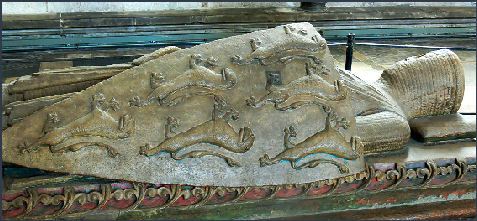 Tomb of William Longespée in Salisbury Cathedral. Source: http://www.englishmonarchs.co.uk/plantagenet_78.html He was sent on missions to France (1202) and to Germany (1209). In 1213–14 he organized King John’s Flemish allies, taking part in the destruction (1213) of the French fleet at Damme, then the port of Bruges, and leading the right wing of the allied army at Bouvines (27th July 1214), where he was captured by the Bishop of Beauvais and held prisoner along with Ferrand, Count of Flanders. Salisbury was exchanged for Robert of Dreux and was back in England by May 1215, when he was employed by John in inspecting the defences of royal castles and fighting the rebels in the southwest.
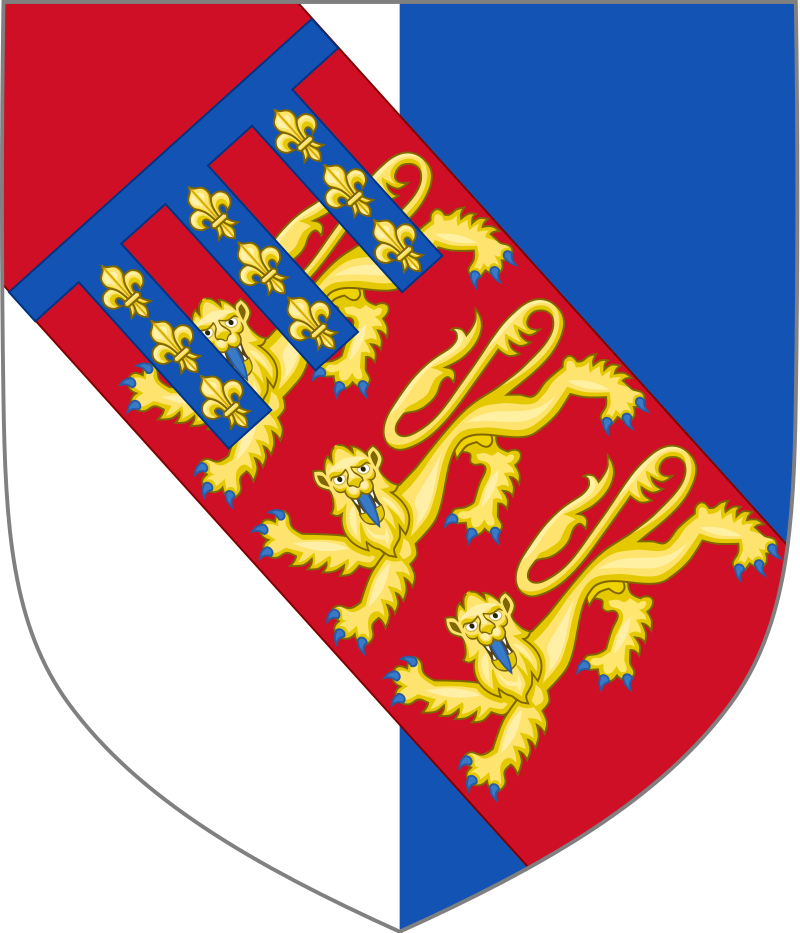
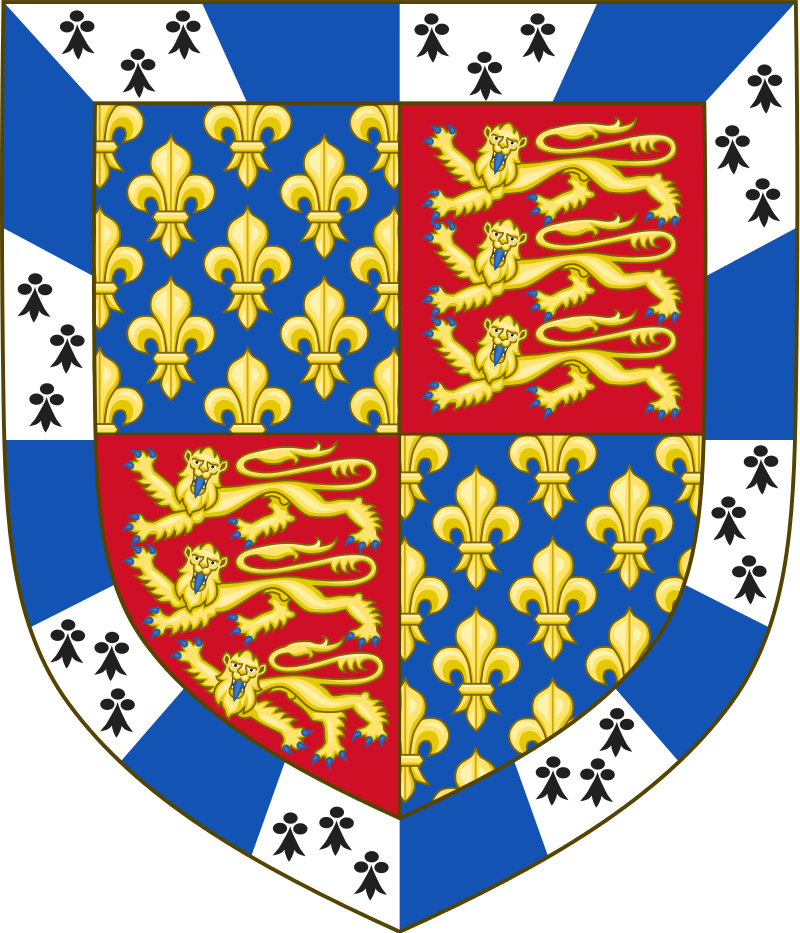
Richard IRichard the Lionheart had at least one illegitimate child: Philip of Cognac, who died young (possibly in battle). He features as Philip the Bastard in Shakespeare's King John. JohnJohn had at least five children with mistresses during his first marriage to Isabelle of Gloucester, and two of those mistresses are known to have been noblewomen. He had several others, 13 or more in total, including Joan, Lady of Wales (wife of Llywelyn the Great) and Richard FitzRoy. John of Gaunt, Duke of LancasterJohn of Gaunt, Duke of Lancaster (6th March 1340 – 3rd February 1399) was an English prince, military leader, and statesman. He was the third of the five sons of King Edward III of England who survived to adulthood. Due to his royal origin, advantageous marriages, and some generous land grants, Gaunt was one of the richest men of his era, and an influential figure during the reigns of both his father, Edward, and his nephew, Richard II. As Duke of Lancaster, he is the founder of the royal House of Lancaster, whose members would ascend to the throne after his death. The House of Lancaster would rule England from 1399 until the time of the Wars of the Roses, when the English crown was disputed with the House of York (formed by the descendants both of his younger brother Edmund, Duke of York and his elder brother, Lionel, Duke of Clarence). As well as children such as Henry of Bolingbroke, who became the first Lancastrian King as Henry IV, Gaunt also fathered five children outside marriage; one early in life by a lady-in-waiting to his mother), the others by Katherine Swynford, his long-term mistress and third wife. They were later legitimised by royal and papal decrees, but which did not affect Henry IV's bar to their having a place in the line of succession. Despite that restriction, through these offspring, surnamed "Beaufort", Gaunt is ancestor to all Scottish monarchs beginning in 1437, and of all English monarchs of the houses of Lancaster and Tudor as well as John Beaufort, 1st Earl of Somerset (1371-1410)John Beaufort, 1st Marquess of Somerset and 1st Marquess of Dorset, later only 1st Earl of Somerset, KG (c. 1371 – 16th March 1410) was an English nobleman and politician. He was the first of the four illegitimate children of John of Gaunt (1340-1399) (third surviving son of King Edward III) by his mistress Katherine Swynford, whom he later married in 1396. Beaufort's surname (properly de Beaufort, "from Beaufort") reflects his birthplace at his father's castle and manor of Beaufort ("beautiful stronghold") in Champagne, 100 miles east of Paris in France. Strangely, John, as an illegitimate son, was granted Arms based, not on his Mother but on his Father's first wife, Blanche of Lancaster who was a descendant of King Henry III, namely the three Lions of England with a blue Label with yellow Fleurs-de-Lys for France. These were placed on a Bend (i.e., at an angle) to represent his illegitimacy. The Beaufort children were declared legitimate twice by parliament during the reign of King Richard II of England, in 1390 and 1397, as well as by Pope Boniface IX in September 1396. Even though they were the grandchildren of Edward III and next in the line of succession after their father's legitimate children by his first two wives, the Beauforts were barred from succession to the throne by their half-brother Henry IV.
On a Chapeau gules turned up ermine, a Lion statant guardant collared componée argent and azure. In other words, a red Hat with ermine trim has a Lion standing on top, looking outwards with a Collar round its neck which matches the pattern from the Bordure. As will be seen, this became a pattern for the Crests of Royal illegitimate children (sons) to come.
John Beaufort's line, however, came to prominence on the female side with Henry VII, whose mother was Lady Margaret Beaufort, and the Tudor Dynasty. Henry was a direct descendant of John Beaufort and heraldry, especially badges, played an important part in supporting the legitimacy of Henry's claim to the Throne. Christ's College in Cambridge, founded by Lady Margaret, is covered in Tudor symbolism and the Beaufort Arms and Badges. 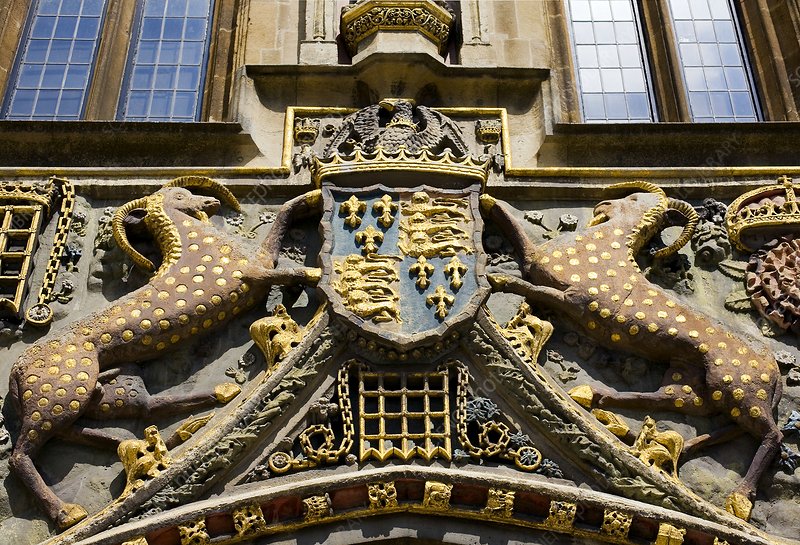 Coat of Arms of Christ's College, University of Cambridge, above the gatehouse of the public entrance. Credit PAUL D STEWART / SCIENCE PHOTO LIBRARY. The Portcullis heraldic badge of the Beauforts, now the emblem of the British Houses of Parliament, is believed to have been based on that of the castle of Beaufort, now demolished. The Portcullis Badge is used in various colours - green for the House of Commons, red for the House of Lords and black for both, as shown below. It is even used by the Speaker when incorporated with the Mace.    Portcullis Badges of the UK Houses of Parliament. Sources: Houses of Parliament - Wikimedia/House of Commons - Free Movement/House of Lords - The Constitution Society. Thomas Beaufort, Duke of Exeter (1377-1426)
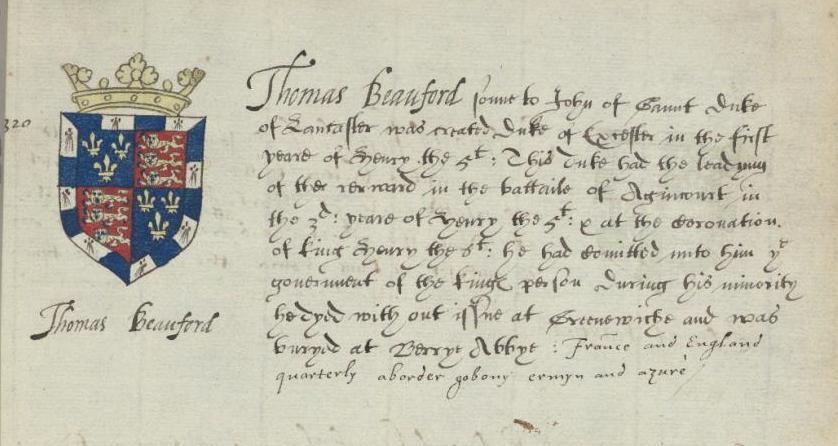 Shield of Arms of Thomas Beaufort (Beauford) from A Book of English Heraldry, original. Source: www.geni.com The Royal Heraldry of England by J. H. & R. V. Pinches, 1974 suggests that when Thomas was created Duke of Exeter by King Henry V on his deathbed, Thomas changed the Bordure to white and France (Argent and Azure fleury Or). The Collar on the Lion in the Crest is suggested to reflect the Bordure in the Arms as well. Supported (no pun intended) by Plantagenet Ancestry: A Study In Colonial And Medieval Families by Douglas Richardson, 2nd Edition, 2011 is the fact that Thomas used two Swans as Supporters. Edward IVEdward IV had at least five illegitimate children, including Arthur Plantagenet, 1st Viscount Lisle (later Lord Deputy of Calais) by his mistress Elizabeth Lucy. Arthur Plantagenet, 1st Viscount Lisle (died 3 March 1542)
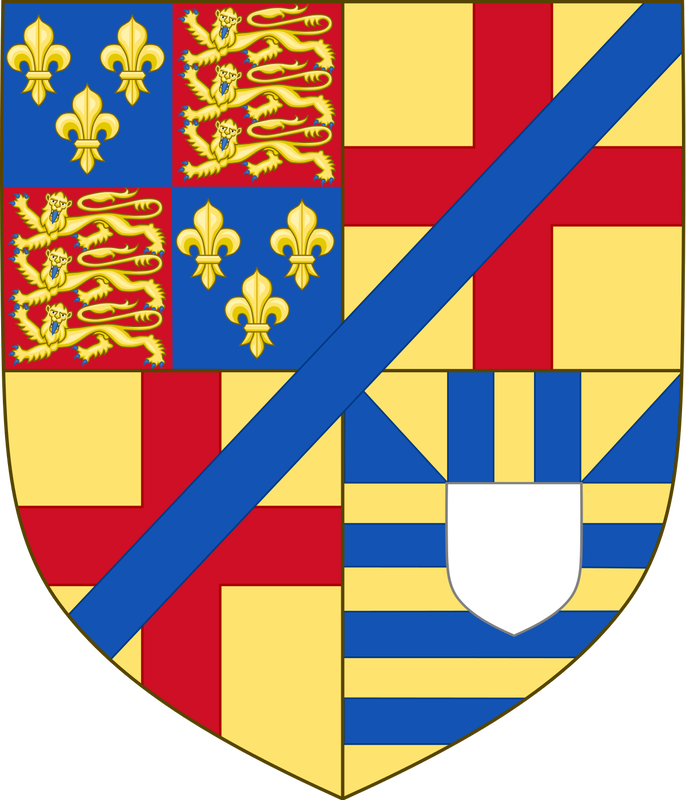
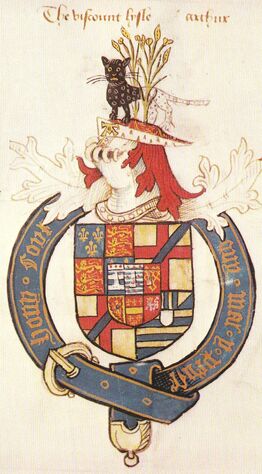
Arthur Plantagenet's Coat of Arms before his first marriage are his paternal arms, with a baton sinister azure for bastardy, of Edward, 4th Duke of York, later King Edward IV: Quarterly 1st: Arms of King Edward III; 2nd & 3rd: Or a cross gules (de Burgh), 4th: Barry or and azure, on a chief of the first two pallets between two base esquires of the second over all an inescutcheon argent (Mortimer).
1st: Quarterly France modern and England (royal arms); 2nd & 3rd: de Burgh; 4th: Mortimer; Over-all an inescutcheon of pretence of Grey, Viscounts Lisle, quarterly of six, 1st: Barry of six argent and azure in chief three torteaux (Grey, Viscount Lisle); 2nd: Barry of argent and azure, an orle of martlets gules(Valence, Earl of Pembroke); 3rd: Gules, seven mascles or conjoined 3, 3, 1 (Ferrers of Groby as heir to de Quincy); 4th: Gules, a lion rampant within a bordure engrailled or (Talbot); 5th: Gules, a fesse between six crosses crosslet or(Beauchamp); 6th: A lion passant crowned (Lisle); in chief a label of three points argent. The whole encircled by the Garter. The canting crest: On a chapeau gules turned up ermine with a capital letter A at the front, a genet cat party per pale sable and argent and a sprig of genista (broom plant). Secondly, in 1529 as her second husband, Arthur married Honor Grenville (1493–1566) the daughter of Sir Thomas Grenville of Stowe in Cornwall, by his wife Isabella Gilbert. She was the widow of Sir John Bassett (who had died 1528) of Umberleigh, Devon. In 1540 several members of the Plantagenet household in Calais were arrested on suspicion of treason, on the charge of plotting to betray the town to the French. Suspicion unavoidably fell upon Arthur as well, and he was recalled to England and eventually arrested on 19th May 1540. During his time at Calais, Arthur had to manage much of their affairs outside Calais by correspondence. Copies of 3,000 of these letters were seized as evidence after Arthur was arrested. They survive in the Public Record Office, and were published in abridged form as the Lisle Letters, becoming a valuable historical resource for a critical period in English history. The actual conspirators were executed, but there was no evidence connecting Arthur with the plot. Nevertheless, he languished in the Tower of London for two years until the king decided to release him. However, upon receiving news that he was to be released he suffered a heart attack and died two days later on 3rd March 1542. Perkin Warbeck closely resembled Edward IV and claimed to be his son Richard of Shrewsbury; it has been theorised that Perkin was one of Edward's illegitimate children. Richard III justified his accession to the throne by claiming that the children of Edward IV were the product of an invalid marriage. Richard IIIRichard III had at least two illegitimate children: John of Gloucester (Captain of Calais for a time) and Katherine, first wife of William Herbert, 2nd Earl of Pembroke. Henry VIISir Roland de Velville was, in one account, the illegitimate son of Henry VII and "a Breton lady." Henry VIIIHenry VIII had one acknowledged illegitimate son Henry FitzRoy, 1st Duke of Richmond and Somerset. As he had many mistresses, six other people are also put forward by historians as possibly being Henry's illegitimate children, including the mercenary Thomas Stukley, the poet Richard Edwardes and two of Mary Boleyn's children. His daughter Elizabeth was also considered illegitimate, as Henry had married her mother, Anne Boleyn, while still married to Queen Catherine. Henry FitzRoy, 1st Duke of Richmond and Somerset (1519-1536)Henry FitzRoy (15th June 1519 – 23rd July 1536), was the son of King Henry VIII of England and his mistress, Elizabeth Blount (lady-in-waiting to Henry VIII's first wife Catherine of Aragon). He the only illegitimate offspring whom Henry VIII acknowledged. 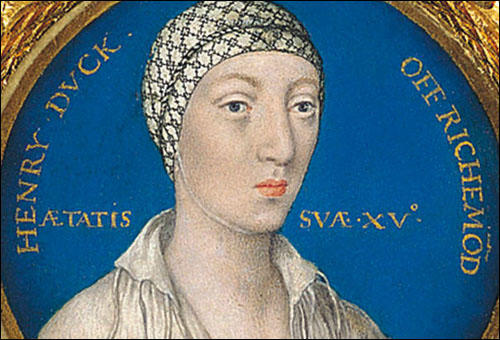 Portrait miniature of Henry FitzRoy, c. 1534/1535 by Lucas Horenbout (1490–1544). Source: Spartacus Educational. Henry FitzRoy is one of the most famous illegitimate children of a British monarch. He will have been conceived when Ctherine was approaching her last confinement with another of Henry's children, a stillborn daughter born in November 1518. Born the following year, Henry had the added bonus of being male when the King had no close male relations and his only surviving child and direct legitimate heir was his daughter, Mary. With a fledgling dynasty, Henry VIII is famous for wanting a secure male heir as, in those days, a ruling female sovereign was unheard-of. We all know, however, that both his daughters inherited Henry VIII's strong will and would be, in their own ways, strong female monarchs. Henry FitzRoy's birth was kept relatively quiet, with his mother dispatched to a priory in Essex for the confinement. Henry FitzRoy's known Godfather was Cardinal Wolsley and it is rumoured that his other Godfather was the King himself. It soon became apparent that the King doted on Henry junior, abandoning all discretion and openly acknowledging the boy, even to the extent of presenting him at Court as soon as he could. But all discretion was go out the window in 1525 when, on 18th June, Henry FitzRoy was brought to Bridewell Palace and left the “right high and noble prince Henry, Duke of Richmond and Somerset”. Not only was he raised to a duke and was the first British duke with a double title, the titles themselves are of significance. Henry VIII's Father was Earl of Richmond before gaining the Crown at Bosworth Field and Somerset, as we have seen, came from Lady Margaret Beaufort's family (Margaret being Henry VIII's Grandmother). It was a proud day for Henry, and for his former mistress Elizabeth; however, the ceremony did nothing to spare the Queen's feelings. Not only that, but other distant male relatives were given titles as part of the same ceremony. Catherine of Aragon was being reminded at every turn that she had not provided the King with a male heir.
In that same year, Richmond, as he came to be known, was granted several other appointments, including Lord High Admiral of England, Lord President of the Council of the North, and Warden of the Marches towards Scotland, the effect of which was to place the government of the north of England in his hands. he was 6 years old... Richmond was made Lord-Lieutenant of Ireland, and there was a plan to crown him king of that country, though the King's counsellors feared that making a separate Kingdom of Ireland whose ruler was not that of England would create another threat similar to the Kingdom of Scotland. When Henry VIII began the process of having his marriage to Catherine of Aragon annulled, it was suggested that Richmond marry his own half-sister Mary in order to prevent the annulment and strengthen Richmond's claim to the throne. Anxious to prevent the annulment and Henry's eventual break with the Roman Catholic Church, the Pope was even prepared to grant a special dispensation for their marriage! At age 14, on 28 November 1533 the Duke instead married Lady Mary Howard, the only daughter of Thomas Howard, 3rd Duke of Norfolk. In 1536 an Act was going through Parliament which disinherited the King's daughter Elizabeth as his heir and permitted the King to designate his successor, whether legitimate or not. There is no evidence that Henry VIII intended to proclaim Richmond his heir, but in theory the Act would have permitted him to do so if he wished Richmond's promising career came to an abrupt end in July 1536 when he was reported ill with "consumption" (usually identified as tuberculosis, but possibly another serious lung complaint). He died at St. James's Palace on 23 July 1536. There are various rumours surrounding his death and especially how his body was treated. Maybe he was carted away in a straw-filled wagon because of fears of contagion. Some believe he was murdered as part of a Catholic conspiracy. Some that he was murdered because of the child that the new Queen in Henry VIII's life, Jane Seymour, was about to give birth to who would turn out to be a legitimate male heir who would become King Edward VI... Scottish KingsMáel Coluim mac Alaxandair (fl. 1124–1134) was an illegitimate son of Alexander I of Scotland (r. 1107–1124) who unsuccessfully claimed his throne. William the Lion (r. 1165–1214) had at least 6 Illegitimate children, including Isabella Mac William. Alexander II's (r. 1214–1249) Illegitimate daughter Marjorie married Alan Durward. Robert the Bruce (r. 1306–1329) had maybe six illegitimate children, including Robert Bruce, Lord of Liddesdale. Robert II (r. 1371–1390) had 13+ illegitimate children, including Thomas Stewart, later Bishop of St Andrews. Robert III (r. 1390–1406) at least two illegitimate children, including John, ancestor of the Shaw Stewart baronets. James II (r. 1437–1460) had an Illegitimate son, John Stewart, Lord of Sticks (d. 1523). James IVJames IV (r. 1488–1513) had at least 5 illegitimate children with his mistresses, including Alexander Stewart, Archbishop of St Andrews, James Stewart, 1st Earl of Moray and Lady Janet Stewart, la Belle Écossaise. James VJames V (r. 1513–1542) had at least 9 illegitimate children with his mistresses, including Lady Jean Stewart (by Elizabeth Bethune), Robert Stewart, 1st Earl of Orkney (by Euphemia Elphinstone) and James Stewart, 1st Earl of Moray (by Margaret Erskine). James Stewart, 1st Earl of Moray (1531 - 1570)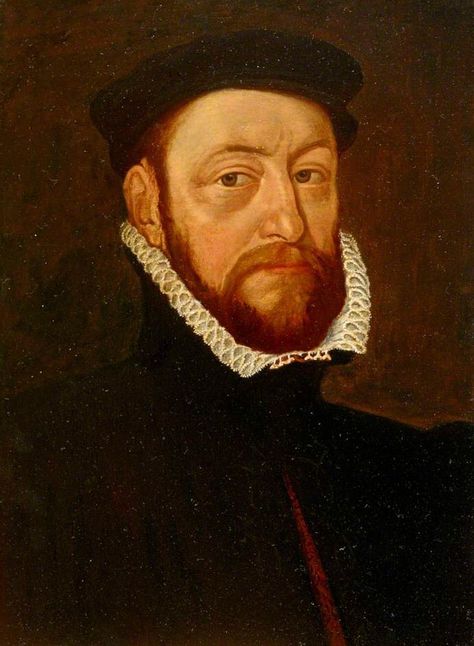 Allegedly James Stewart Earl of Moray, Regent of Scotland by Hugh Monro: National Galleries of Scotland. Source: Pinterest.
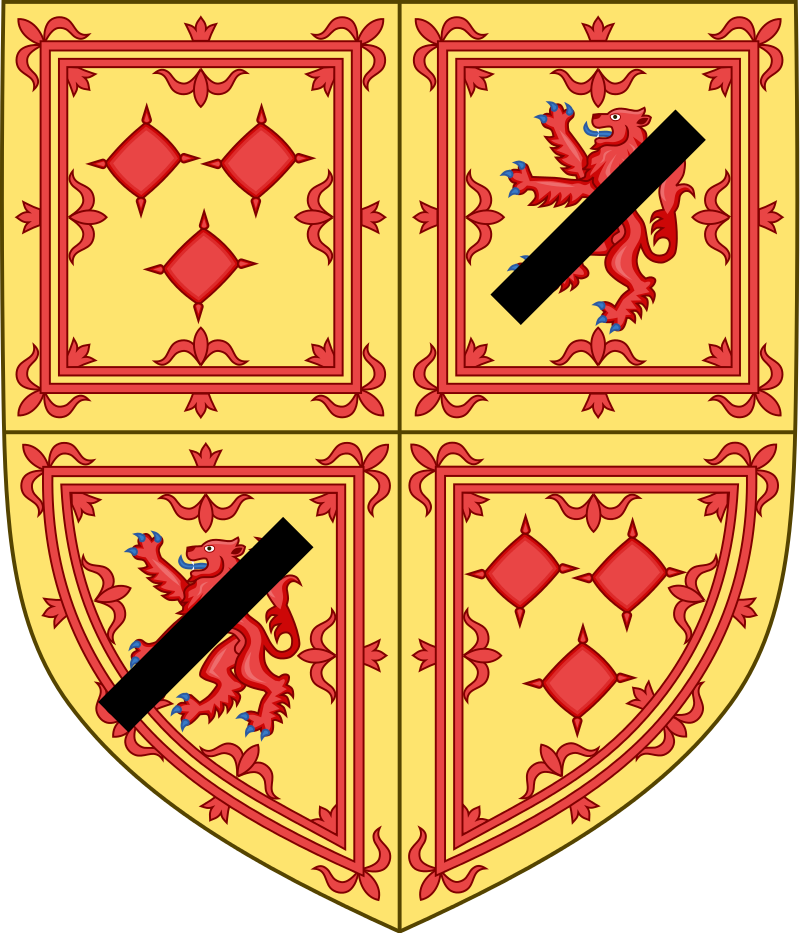
When Mary abdicated in 1567, Moray was appointed regent for her year-old son, King James VI. He suppressed her final effort to regain power when he routed her forces at Langside on 13th May 1568, and she, in turn, fled to England. A substantial portion of the nobility continued to maintain Mary’s right to rule, however, and Moray had difficulty putting into practice his vigorously Protestant and pro-English policies. He was assassinated in January 1570 by James Hamilton of Bothwellhaugh, who favoured Mary, while riding through Linlithgow. Moray's Coat of Arms is made up of Moray in the first and fourth Quarters and the Royal Arms of Scotland 'debruised' (crossed or partly covered) by a black Baton Sinister to denote illegitimacy. The Moray Arms are shown with a yellow Field (or background) as opposed to the white of the County of Moray and were used as such another, earlier Earl of Moray, Thomas Randolph (c. 1278 – 20th July 1332) who also acted as Regent. It was known that Randolph was the nephew of King Robert the Bruce, although which of the King's sister's was Randolph's mother is unsure. Thomas Randolph was Regent when Robert the Bruce's 5-year-old son David succeeded him. Robert Stewart, 1st Earl of Orkney (1533 – 1593)
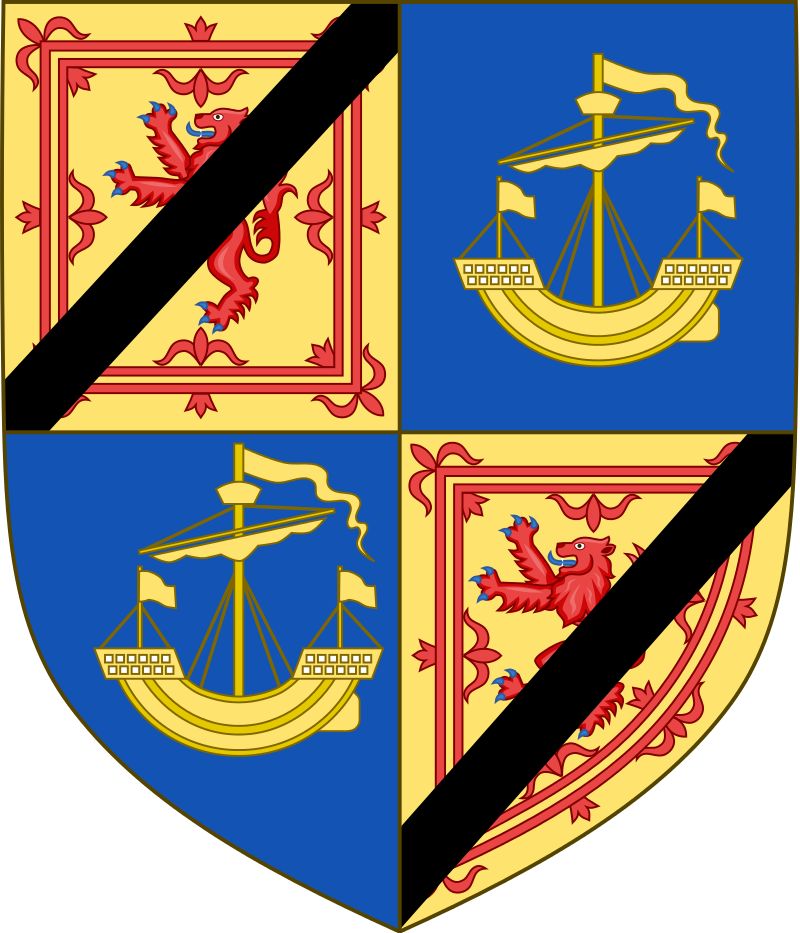
In 1568 Robert extended his landholdings in Orkney by exchanging his interests in Holyrood Abbey with the Orkney estates of Bishop Adam Bothwell, in an arrangement apparently forced on the Bishop. Robert's new properties included a large estate around Birsay which had historically been the site of a cathedral and for some centuries had been used by the Bishops of Orkney as the location of a country retreat. Over the following five years Robert built what is now known as the Earl's Palace in Birsay. By 1570 Bishop Bothwell and many others from Orkney were complaining that Robert's approach amounted to nothing less than tyranny: in effect his using islanders as slave labour on his construction projects. His chief instrument of oppression, especially in Shetland, was his half brother, Laurence Bruce, who he appointed Sheriff of Shetland. In 1575 Robert was imprisoned in Edinburgh by the Regent for James VI, James Douglas, Earl of Morton: less because of his behaviour towards the islanders than because it came to light that he had offered Orkney to the King of Denmark, an act that amounted to treason. The following year he was also indicted in Edinburgh. for misuse of power. However, Robert was released, and by 1581 engineered the execution of James Douglas, Earl of Morton by convincing his young half nephew, James VI, that Morton had had a hand in the murder of James' father, Lord Darnley. In the same year James VI made Robert Stewart the 1st Earl of Orkney, Lord of Shetland, and Knight of Birsay. The Earldom of Orkney replaced the short-lived Dukedom of Orkney, which had been granted in 1567 by Mary Queen of Scots to her third husband James Hepburn, 4th Earl of Bothwell. This was among the titles forfeited by Bothwell after Mary's abdication. Although Robert was the 1st Earl of this creation, there had been a previous creation of the Earldom of Orkney, bestowed on Henry Sinclair by King Håkon of Norway (then ruler of Orkney) in 1379. When James III secured Orkney and Shetland for Scotland in 1470, William Sinclair, 3rd Earl of Orkney relinquished his Earldom to the King (he had other titles) in return for estates around Ravenscraig (now on the edge of Kirkcaldy) in Fife. Further complaints followed about Robert's treatment of islanders, but he survived to die peacefully in his bed on 4th February 1593. He was succeeded by his, if anything, even less likeable son, Patrick Stewart, as 2nd Earl of Orkney. Robert Stewart left an indelible mark on the Northern Isles, both in terms of his impact as a tyrant, and in stone. The considerable ruins of the Earl's Palace at Birsay still stand, and the ruins of the Palace he built near the southern tip of Shetland's Mainland now form part of the incredible Jarlshof complex. Robert's Coat of Arms shows the Royal Arms of Scotland debruised by a bendlet sinister in black to show that he was the illegitimate son of the King, quartered with a Ship on a blue Field/background which represents Orkney. The modern Shield of Orkney shares these Arms with those representing Norway, namely a golden crowned Lion carrying an Axe. Charles II Charles II fathered at least 20 illegitimate children, of whom he acknowledged 14. The most famous of these was James Scott, 1st Duke of Monmouth, his son by Lucy Walter. After Charles' death, Monmouth led a rebellion against his uncle James II. When Nell Gwynn brought her first child to Charles, she told it, "Come hither you little Bastard and speak to your father!". "Nay, Nellie, do not call the child such a name", said the king. "Your Majesty has given me no other name by which I may call him." Charles then named the child "Beauclerk" and bestowed the title "Earl of Burford". Heraldically, and with only a couple of exceptions, the College of Arms and the King fell into a pattern of Batons and crests with upturned Chapeaux (as in the medieval Royal Crests). A fine and probably necessary pattern to regulate teh royal machine!
|
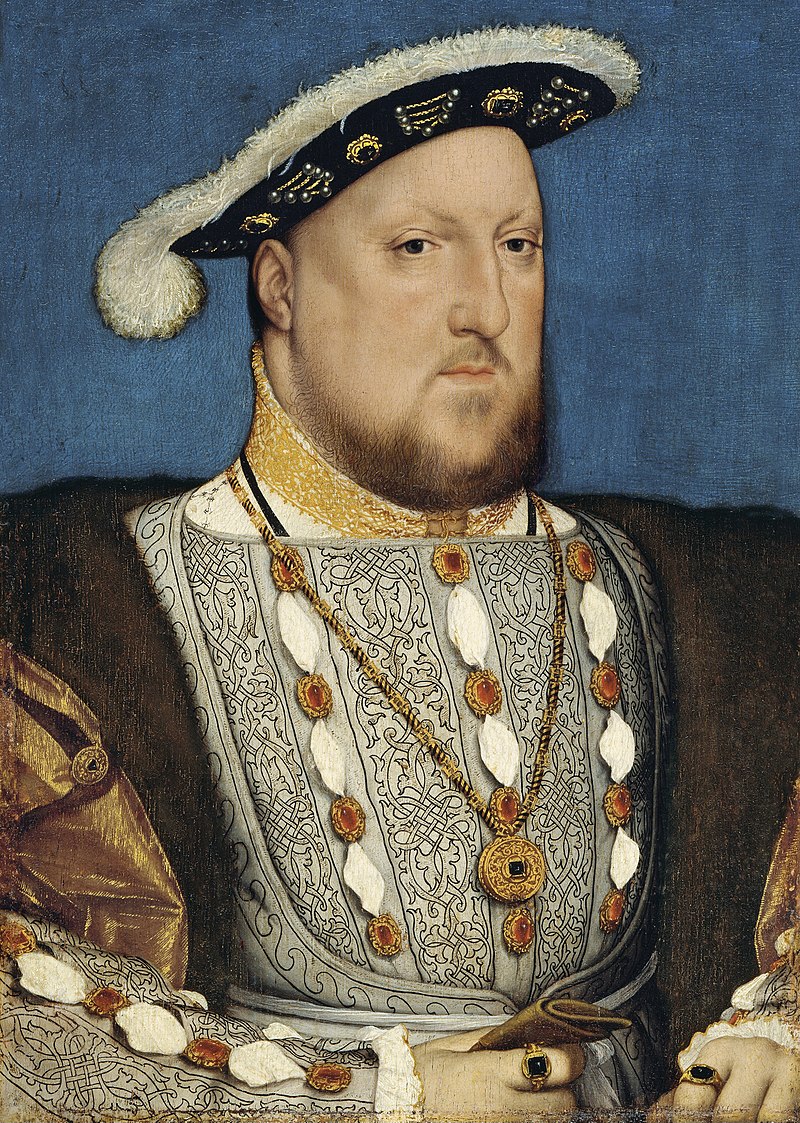
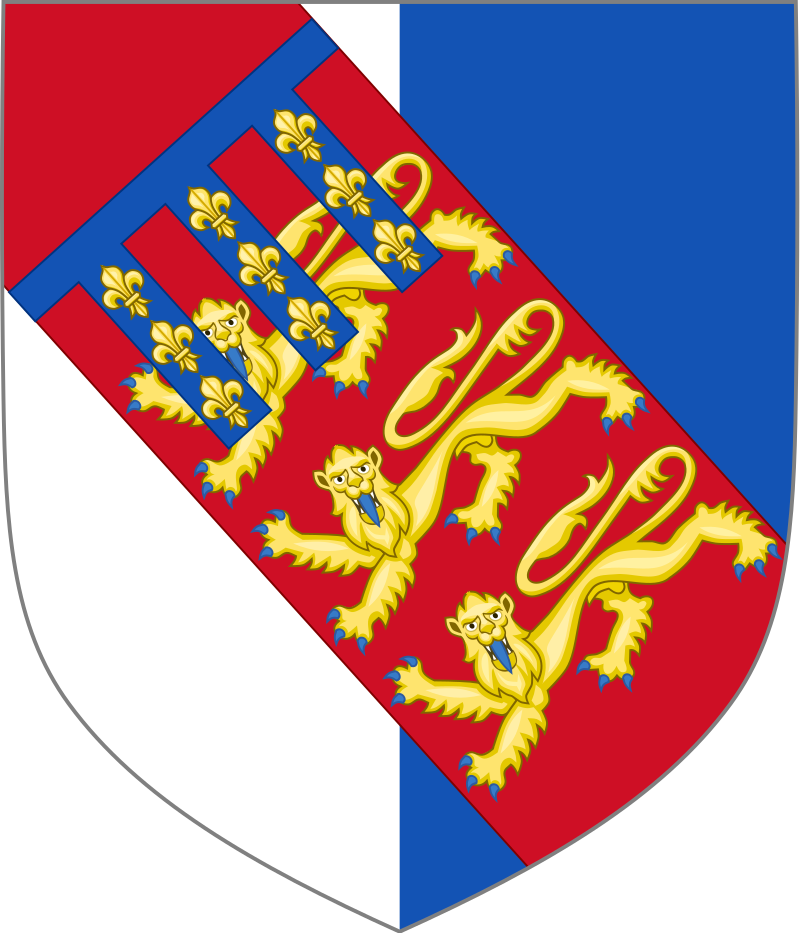
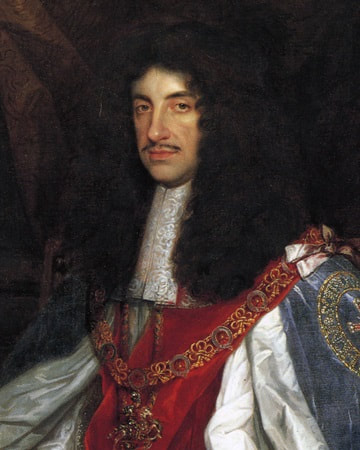
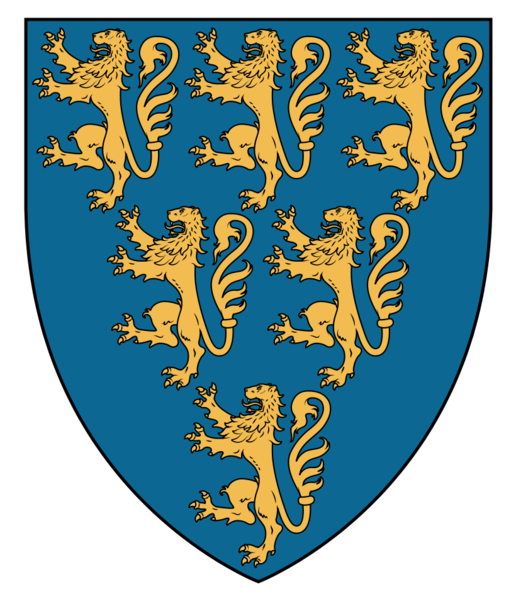
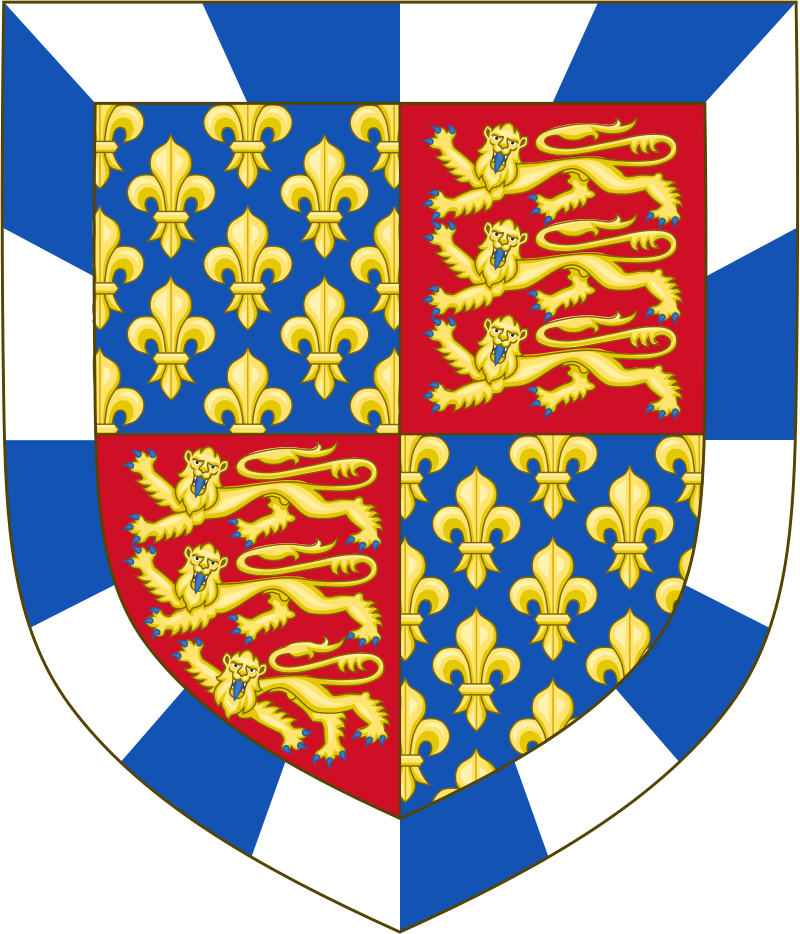
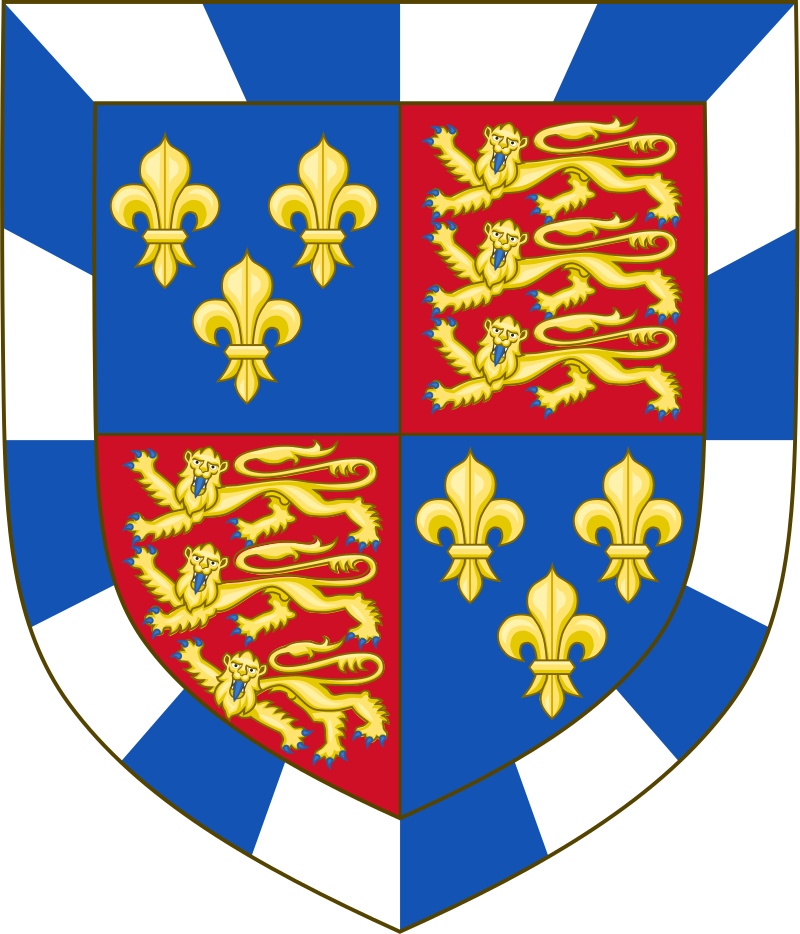
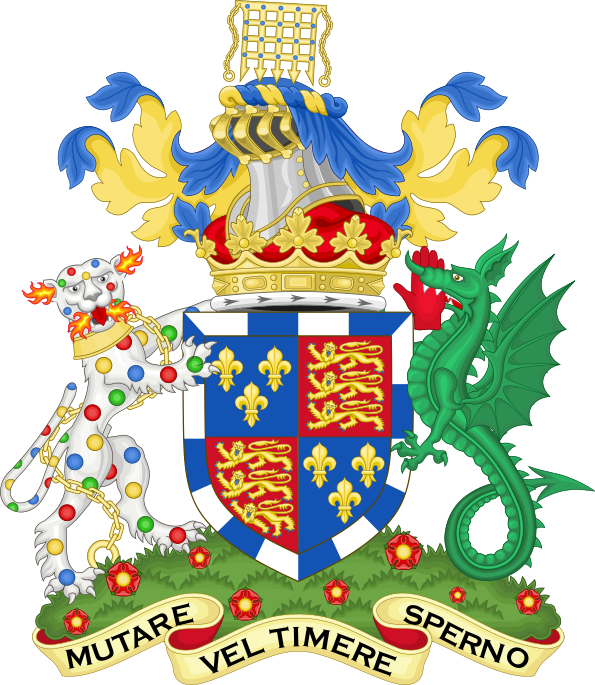
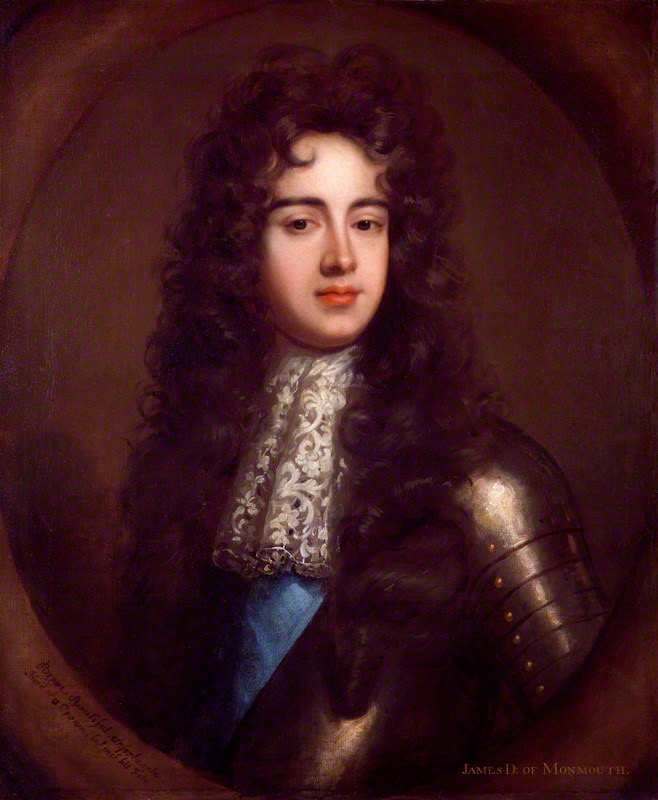
| James Scott, 1st Duke of Monmouth, 1st Duke of Buccleuch, (9th April 1649 – 15th July 1685) was originally called James Crofts or James Fitzroy. Hhe was born in Rotterdam in the Netherlands, the eldest and possibly most famnous illegitimate son of King Charles II and his mistress Lucy Walter. He served in the Second Anglo-Dutch War and commanded English troops taking part in the Third Anglo-Dutch War before commanding the Anglo-Dutch brigade fighting in the Franco-Dutch War. He led the unsuccessful Monmouth Rebellion in 1685, an attempt to depose his uncle, King James II and VII. After one of his officers declared Monmouth the legitimate King in the town of Taunton in Somerset, Monmouth attempted to capitalise on his Protestantism and his position as the son of Charles II, in opposition to James, who was a Roman Catholic. The rebellion failed, and Monmouth was beheaded for treason on 15 July 1685. | 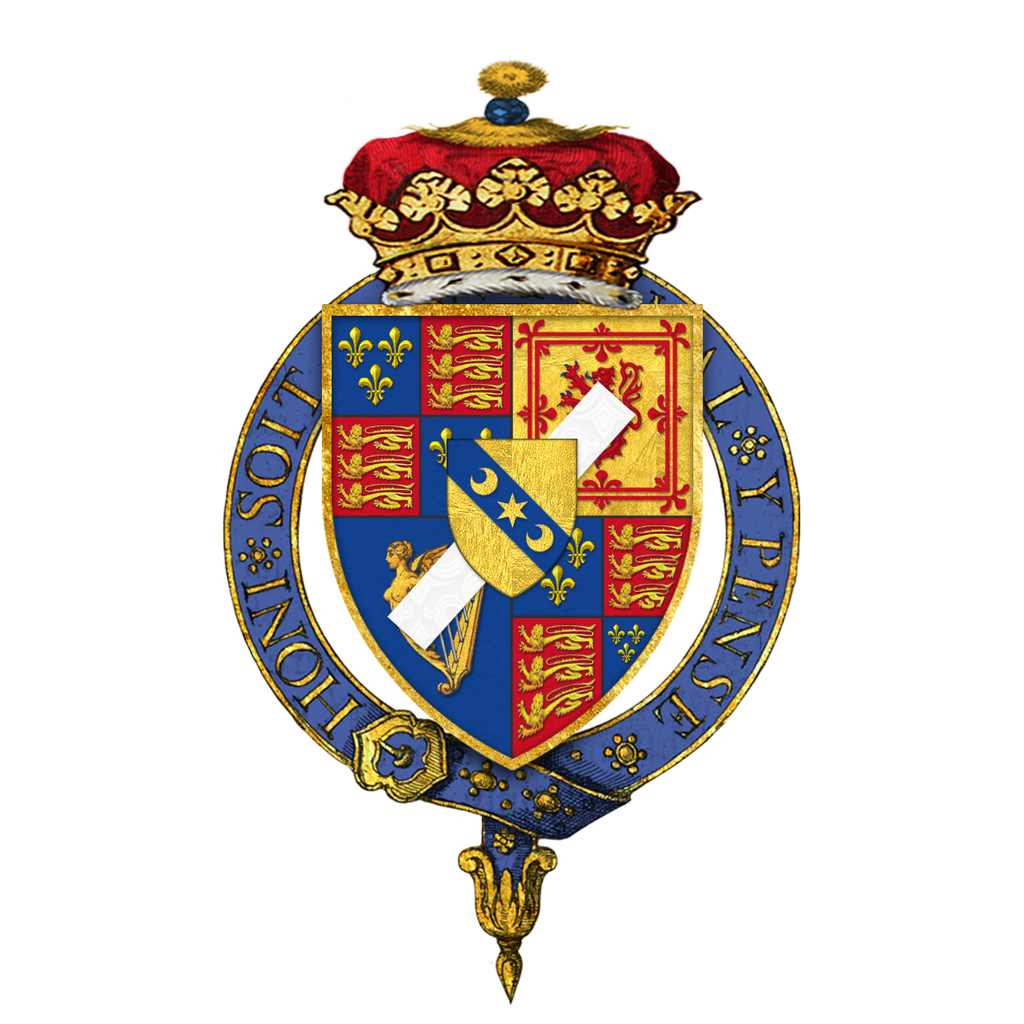 Coat of Arms of James Scott, 1st Duke of Monmouth. Authorage: Wikipedia/Rs-nourse |
Monmouth was initially granted a Coat of Arms for his installation as Knight of the Garter:
Shield: Quarterly, 1st and 4th, Ermine, on a Pile gules three Lions passant guardant or; 2nd and 3rd, Or, within a double Tressure flory counterflory gules, on an Inescutcheon azure, three Fleurs-de-Lys gold.
Crest: Upon a Chapeau gules turned up ermine, a Dragon passant or gorged with a Crown having a Chain gules.
Supporters: Dexter, a Unicorn argent, armed, maned and unguled or, gorged with a Crown having a Chain gules affixed thereto: Sinister, a Hart argent, attired and unguled or, gorged with a Crown having a Chain gules affixed thereto.
On 20th April 1663 Monmouth married the wealthy Scottish peeress Anne Scott, who had succeeded to her sister Mary Scott's titles as 4th Countess of Buccleuch, 5th Baroness Scott of Buccleuch and 5th Baroness Scott of Whitchester and Eskdaill two years earlier in her own right. She and Monmouth were created Duke and Duchess of Buccleuch on that day and Monmouth took on her surname.
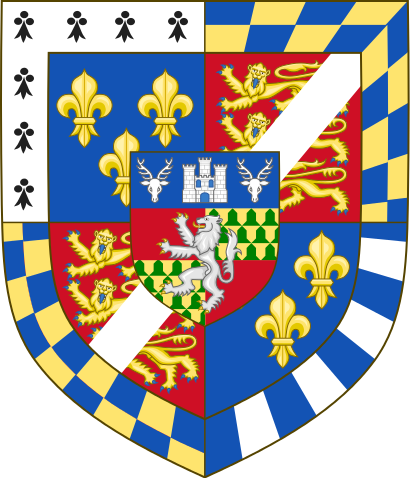
Subsequently, in a grant dated 1667, whilst retaining the Crest and Supporters, Monmouth was assigned the Royal Arms of his Father with a white Baston Sinister (a cut-off, narrow strip running the opposite way to normal, namely from upper right to the lower left). The choice of a plain white Baston, along with the Dragon of the Crest, may be thought of as provocatively similar to the plain white Label of an Heir Apparent to the Throne (Prince of Wales).
On top is an Inescutcheon of the Coat of Arms of the Scott family to show the importance of Monmouth's marriage to Anne.
Subsequently, in a grant dated 1667, whilst retaining the Crest and Supporters, Monmouth was assigned the Royal Arms of his Father with a white Baston Sinister (a cut-off, narrow strip running the opposite way to normal, namely from upper right to the lower left). The choice of a plain white Baston, along with the Dragon of the Crest, may be thought of as provocatively similar to the plain white Label of an Heir Apparent to the Throne (Prince of Wales).
On top is an Inescutcheon of the Coat of Arms of the Scott family to show the importance of Monmouth's marriage to Anne.
Or, on a Bend azure a Mullet of six points between two Crescents of the field.
These Arms still feature in the Achievement of the Dukes of Buccleuch to this day and returned to the British Royal Family when Lady Alice Montagu Douglas Scott, the daughter of the 7th Duke married HRH The Prince Henry, Duke of Gloucester, son of HM King George V, in 1935.
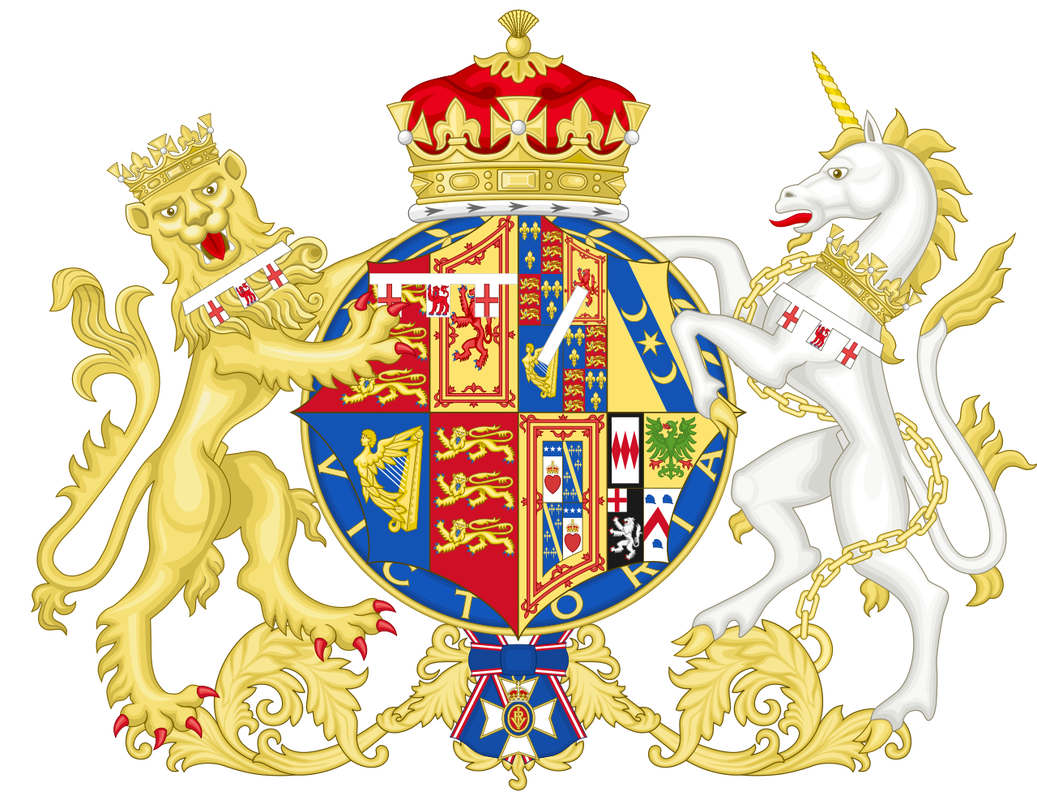
Coat of Arms of HRH Princess Alice, Duchess of Gloucester (Lady Alice Christabel Montagu Douglas Scott). Wife of Prince Henry, Duke of Gloucester. Authorage: Wikipedia/Sodacan.
By Elizabeth Boyle, Viscountess Shannon (1622–1680)
Charlotte FitzRoy, Countess of Yarmouth (1650–1684).
By Catherine Pegge
Charles FitzCharles, 1st Earl of Plymouth (1657–1680)
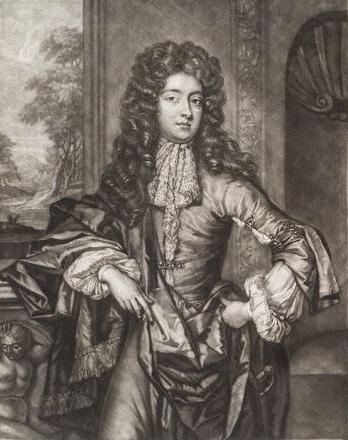
Charles Fitzcharles, 1st Earl of Plymouth (1657 – 17th October 1680) was the illegitimate son of Charles II of England and Catherine Pegge, was probably born in Bruges, West Flanders. His mother's liaison with the exiled king had come to an end by 1658, and he was brought up by her in the Spanish Netherlands, probably where he earned the nickname 'Don Carlos', with the support of his maternal grandfather, Thomas Pegge of Yeldersley.
He had a sister called Catherine FitzCharles who became a nun
FitzCharles married under the name Charles Earle to the third daughter of Thomas Osborne, 1st Duke of Leeds, Lady Bridget Osborne, at the parish church at Wimbledon, Surrey, on 19th September 1678.
Commissioned on 13th July 1680 as the colonel of a new regiment, he arrived in Tangier on 2nd July 1680, having already left England prior to the commission. Conducting assaults to remove the Moors from positions outside the city walls, he drank from contaminated water and fell ill with dysentery. After being carried back to the city, his condition worsened and he died of the ‘Bloody flux’ on 17th October 1680. Some say he was purposefully put on the mission to get rid of him.
Charles's body was conveyed back to England by his servants and interred on 18th January 1681 in Henry VII's chapel, Westminster Abbey, in the vault vacated of the bodies of the Cromwell family.
FitzCharles was assigned the Royal Coat of Arms of his Father with a Baton Sinister vair which is fur representing the alternate back and belly of a squirrel.
His Crest and Supporters were:
He had a sister called Catherine FitzCharles who became a nun
FitzCharles married under the name Charles Earle to the third daughter of Thomas Osborne, 1st Duke of Leeds, Lady Bridget Osborne, at the parish church at Wimbledon, Surrey, on 19th September 1678.
Commissioned on 13th July 1680 as the colonel of a new regiment, he arrived in Tangier on 2nd July 1680, having already left England prior to the commission. Conducting assaults to remove the Moors from positions outside the city walls, he drank from contaminated water and fell ill with dysentery. After being carried back to the city, his condition worsened and he died of the ‘Bloody flux’ on 17th October 1680. Some say he was purposefully put on the mission to get rid of him.
Charles's body was conveyed back to England by his servants and interred on 18th January 1681 in Henry VII's chapel, Westminster Abbey, in the vault vacated of the bodies of the Cromwell family.
FitzCharles was assigned the Royal Coat of Arms of his Father with a Baton Sinister vair which is fur representing the alternate back and belly of a squirrel.
His Crest and Supporters were:
Crest: On a Chapeau glues turned up ermine, a Lion passant guardant or ducally crowned per Pale argent and azure, gorged with a collar vairé affixed thereto a Chain the links argent and azure reflexed over the back.
Supporters: Two Dragons gules, armed and langued azure, each gorged with a Collar vairé affixed thereto a Chain as in the Crest.
Charles FitzCharles, 1st Earl of Plymouth (1657–1680), known as "Don Carlo", created Earl of Plymouth (1675)
Catherine FitzCharles (born 1658; she either died young or became a nun at Dunkirk).
By Barbara Palmer, 1st Duchess of Cleveland (1641–1709)
Anne Lennard, Countess of Sussex (1661–1722). She may have been the daughter of Roger Palmer, but Charles accepted her.
Charles FitzRoy, 2nd Duke of Cleveland (1662–1730)
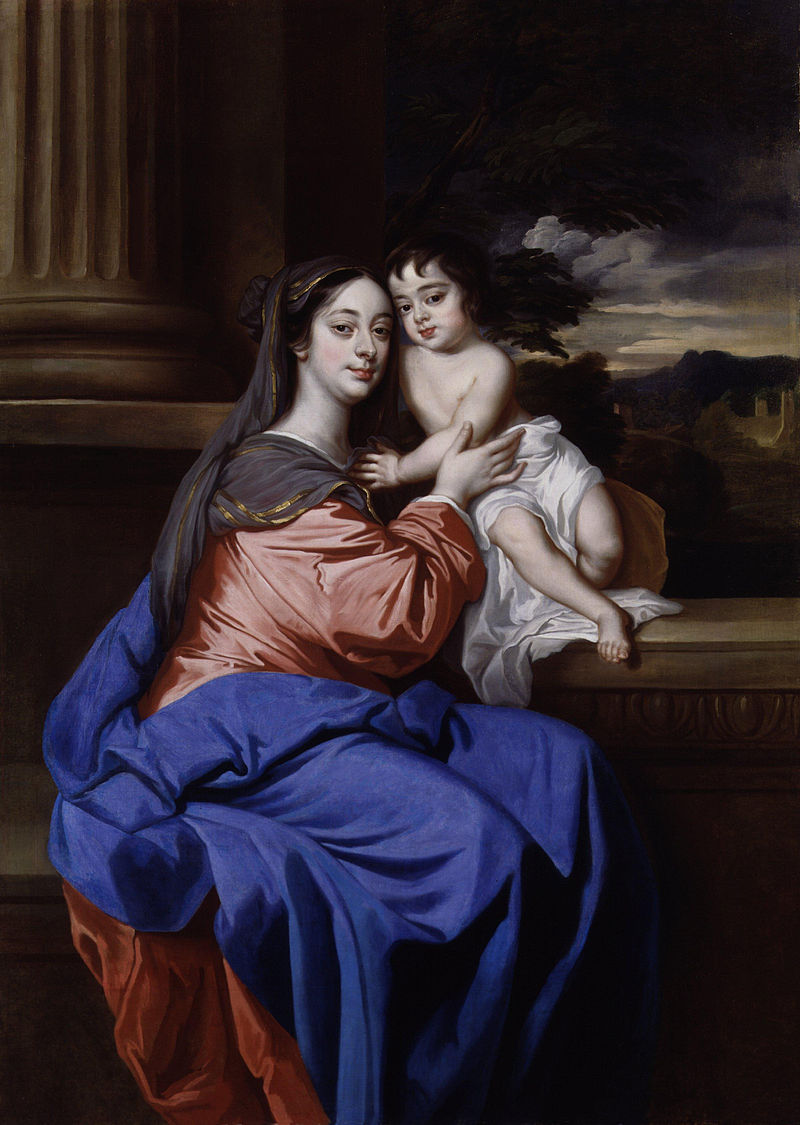
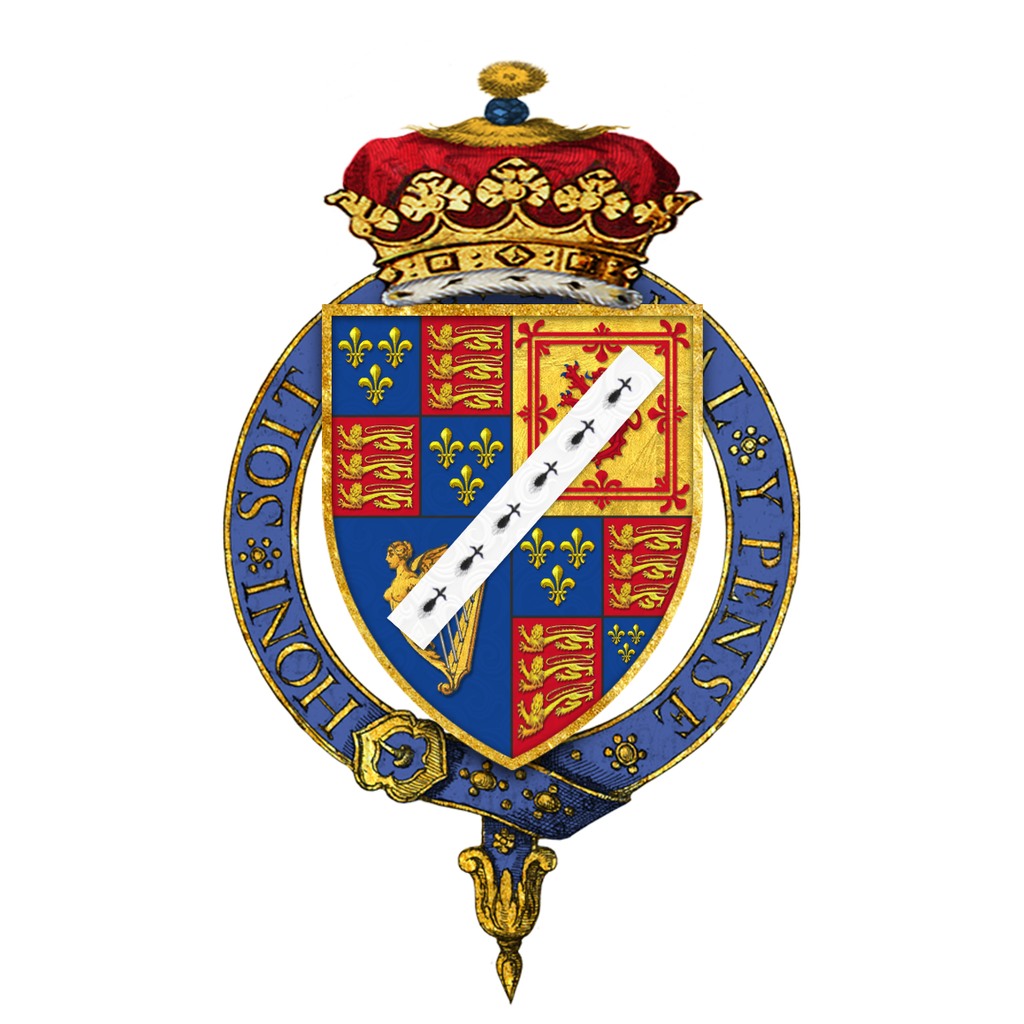
Charles Palmer, later Charles FitzRoy (18th June 1662 – 9th September 1730) was the eldest son of Barbara Villiers, later 1st Duchess of Cleveland, and one of the illegitimate sons of King Charles II. He was styled Baron Limerick before 1670 and Earl of Southampton between 1670 and 1675. He was known as the Duke of Southampton from 1675 until 1709 when he succeeded his mother to the dukedom of Cleveland.
His title as Baron Limerick came from his putative father Roger Palmer, 1st Earl of Castlemaine, but his birth marked the separation of his parents. Lord Castlemaine, a Roman Catholic, had him baptised into the Roman Catholic faith, but six days later the King had him re-christened into the Church of England.
In 1670, at the age of eight, he was betrothed to Mary Wood, only child and sole heiress of Sir Henry Wood, 1st Baronet, Clerk of the Green Cloth, but with the proviso that the marriage be delayed until Mary was aged sixteen. Following the death of her father, the Duchess of Cleveland more or less abducted Mary, with the intention of bringing her up with her own children.
In 1675 Charles was created Duke of Southampton along with the subsidiary titles of Earl of Chichester and Baron Newbury. The marriage to Mary Wood took place in 1679, but within months the new Duchess died of smallpox, leaving no children of the marriage.
In 1694 the Duke married secondly Anne, a daughter of Sir William Poultney, of Misterton, Leicestershire, and they had six children.
On the death of his mother in 1709 the Duke also became second Duke of Cleveland by a special remainder in the grant of the dukedom which set aside his illegitimacy. He died on 9th September 1730 and was buried at Westminster Abbey. He was succeeded by his eldest son William FitzRoy (1698–1774), who died without issue, when all his titles became extinct.
Charles was assigned his Father's Royal Arms debruised by a Baton Sinister ermine.
His Crest and Supporters were:
His title as Baron Limerick came from his putative father Roger Palmer, 1st Earl of Castlemaine, but his birth marked the separation of his parents. Lord Castlemaine, a Roman Catholic, had him baptised into the Roman Catholic faith, but six days later the King had him re-christened into the Church of England.
In 1670, at the age of eight, he was betrothed to Mary Wood, only child and sole heiress of Sir Henry Wood, 1st Baronet, Clerk of the Green Cloth, but with the proviso that the marriage be delayed until Mary was aged sixteen. Following the death of her father, the Duchess of Cleveland more or less abducted Mary, with the intention of bringing her up with her own children.
In 1675 Charles was created Duke of Southampton along with the subsidiary titles of Earl of Chichester and Baron Newbury. The marriage to Mary Wood took place in 1679, but within months the new Duchess died of smallpox, leaving no children of the marriage.
In 1694 the Duke married secondly Anne, a daughter of Sir William Poultney, of Misterton, Leicestershire, and they had six children.
On the death of his mother in 1709 the Duke also became second Duke of Cleveland by a special remainder in the grant of the dukedom which set aside his illegitimacy. He died on 9th September 1730 and was buried at Westminster Abbey. He was succeeded by his eldest son William FitzRoy (1698–1774), who died without issue, when all his titles became extinct.
Charles was assigned his Father's Royal Arms debruised by a Baton Sinister ermine.
His Crest and Supporters were:
Crest: On a Chapeau gules turned up ermine, a Luion statant guardant ducally crowned azure, gorged with a Collar companée ermine and azure.
Supporters: Dexter, a Lion guardant or ducally crowned azure, gorged with a Collar componée ermine and azure; Sinister, a Greyhound argent, collared as the dexter.
Henry FitzRoy, 1st Duke of Grafton (1663–1690)

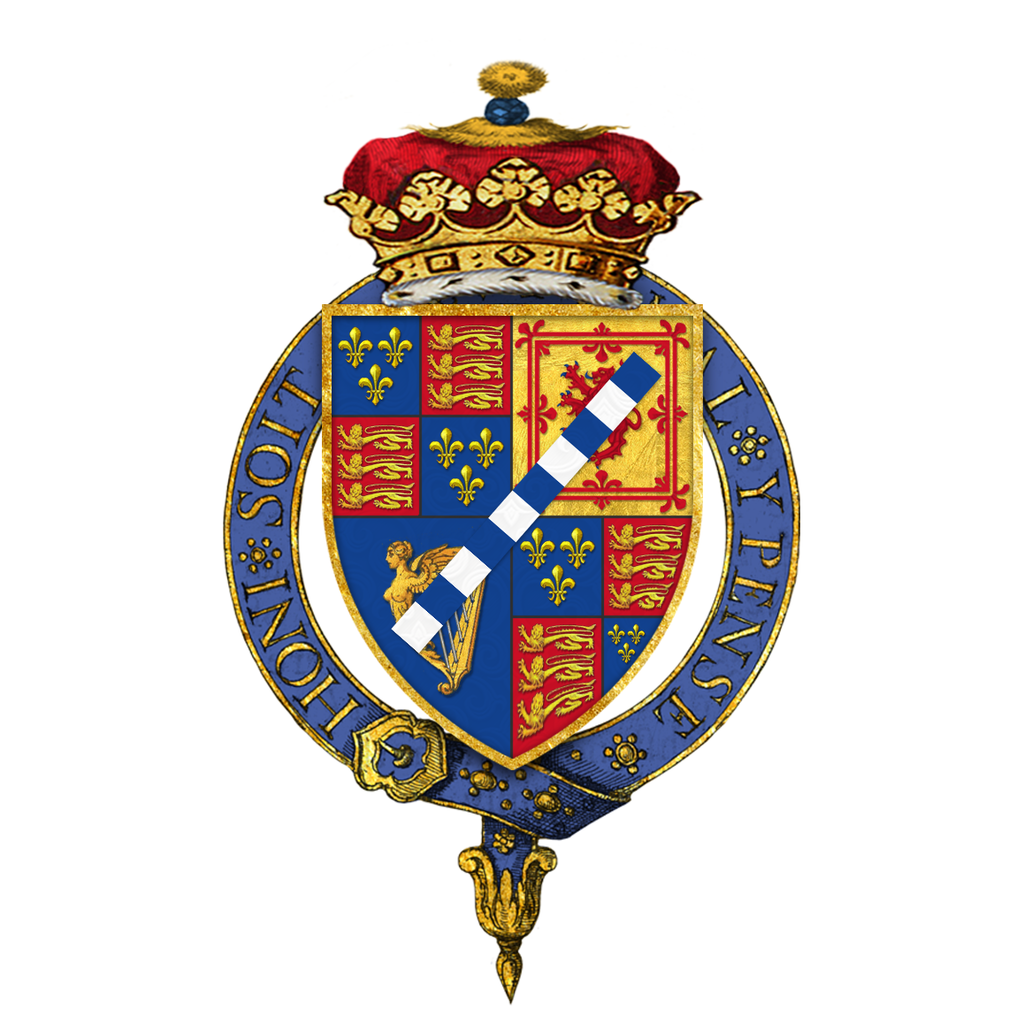
Henry FitzRoy, 1st Duke of Grafton (28th September 1663 – 9th October 1690) was born to Barbara Villiers, Countess of Castlemaine/Duchess of Cleveland and was the illegitimate son of King Charles II.
On 1st August 1672 he was married at the age of nine to the five-year-old Isabella, daughter and heiress of Henry Bennet, 1st Earl of Arlington. The wedding ceremony was repeated on 7th November 1679, and through their son Charles FitzRoy, 2nd Duke of Grafton, the couple were ancestors of Diana, Princess of Wales.
At the time of his marriage, Henry FitzRoy was created Baron Sudbury, Viscount Ipswich, and Earl of Euston; in 1675 he was created Duke of Grafton, and Charles II made him a Knight of the Garter in 1680. He was appointed colonel of the Grenadier Guards in 1681. He had the reputation as the most able of Charles II's sons.
FitzRoy was brought up as a sailor and saw military action at the siege of Luxembourg in 1684. In that year, he received a warrant to supersede Sir Robert Holmes as Governor of the Isle of Wight, when the latter was charged with making false musters. However, Holmes was acquitted by court-martial and retained the governorship. In 1686 he killed John Talbot, brother of the Earl of Shrewsbury, in a duel.
At King James II's coronation, Grafton was Lord High Constable. During the rebellion of the Duke of Monmouth he commanded the royal troops in Somerset; but later acted with John Churchill, and joined William of Orange to overthrow the King in the Glorious Revolution of 1688.
FitzRoy died in Ireland in 1690 of a wound received at the storming of Cork while leading William's forces, aged only 27. His body was returned to England for burial.
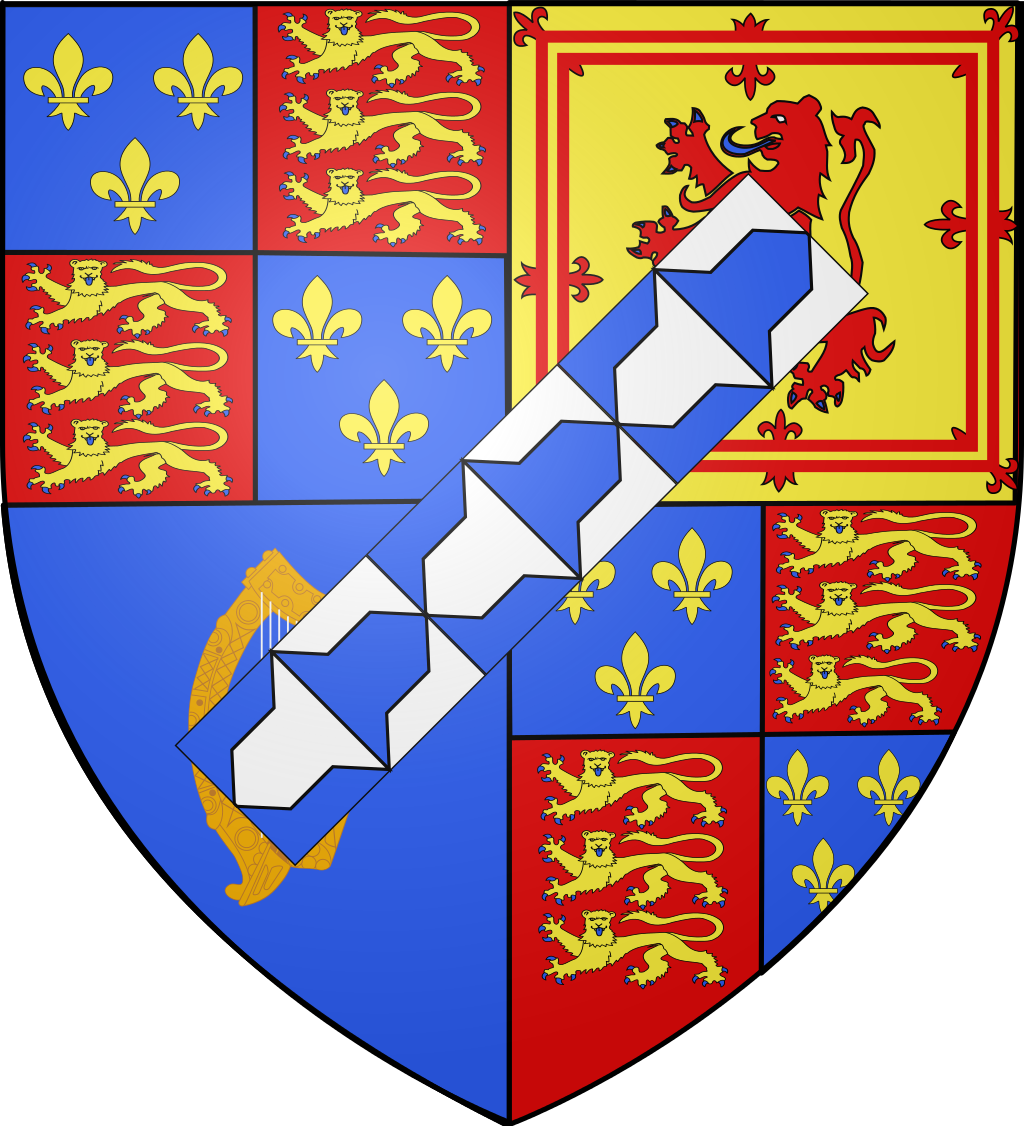
Henry FitzRoy was assigned the Royal Arms of his Father King Charles II with a Baton Sinister compony (divided into a single row of squares) in blue and white.
Henry's Crest and Supporters were as follows:
On 1st August 1672 he was married at the age of nine to the five-year-old Isabella, daughter and heiress of Henry Bennet, 1st Earl of Arlington. The wedding ceremony was repeated on 7th November 1679, and through their son Charles FitzRoy, 2nd Duke of Grafton, the couple were ancestors of Diana, Princess of Wales.
At the time of his marriage, Henry FitzRoy was created Baron Sudbury, Viscount Ipswich, and Earl of Euston; in 1675 he was created Duke of Grafton, and Charles II made him a Knight of the Garter in 1680. He was appointed colonel of the Grenadier Guards in 1681. He had the reputation as the most able of Charles II's sons.
FitzRoy was brought up as a sailor and saw military action at the siege of Luxembourg in 1684. In that year, he received a warrant to supersede Sir Robert Holmes as Governor of the Isle of Wight, when the latter was charged with making false musters. However, Holmes was acquitted by court-martial and retained the governorship. In 1686 he killed John Talbot, brother of the Earl of Shrewsbury, in a duel.
At King James II's coronation, Grafton was Lord High Constable. During the rebellion of the Duke of Monmouth he commanded the royal troops in Somerset; but later acted with John Churchill, and joined William of Orange to overthrow the King in the Glorious Revolution of 1688.
FitzRoy died in Ireland in 1690 of a wound received at the storming of Cork while leading William's forces, aged only 27. His body was returned to England for burial.
Henry FitzRoy was assigned the Royal Arms of his Father King Charles II with a Baton Sinister compony (divided into a single row of squares) in blue and white.
Henry's Crest and Supporters were as follows:
Crest: On a Chapeau gules turned up ermine, a Lion statant guardant or, ducally crowned azure, collared counter componée ermine and azure.
Supporters: Dexter, a Lion guardant or, ducally crowned azure, gorged with a Collar counter componée ermine and azure; Sinister, a Greyhound argent gorged as the dexter.
Charlotte Lee, Countess of Lichfield (1664–1717). Her Arms before marriage were The Royal Arms debruised by a Baston sinister ermine.
George FitzRoy, 1st Duke of Northumberland (1665–1716)

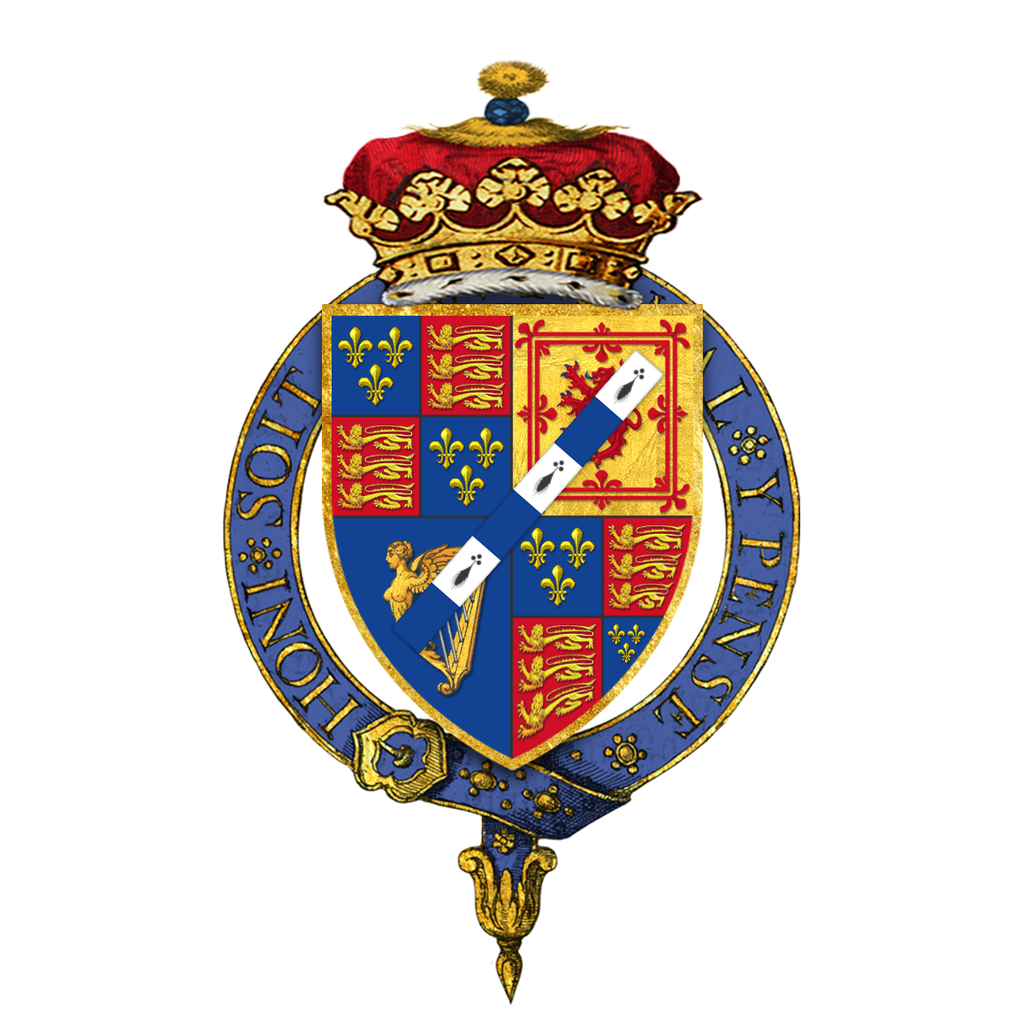
George FitzRoy (alias Palmer) (28th December 1665 – 28th June 1716) was the third and youngest illegitimate son of King Charles II, by Barbara, Countess of Castlemaine (alias Barbara Villiers, Duchess of Cleveland). He was born in 'a fellow's chamber' at Merton College, Oxford in December 1665 and was created Baron of Pontefract in the county of Yorkshire, Viscount Falmouth in the county of Cornwall, and Earl of Northumberland on 1st October 1674.
He was employed on secret service in Venice in 1682 and, upon his return to England, was created Duke of Northumberland on 6th April 1683, and elected and installed knight of the Garter on 10th January and 8th April 1684 respectively. He served as a volunteer on the side of the French at the Siege of Luxemburg in the Summer of the same year, returning to England in the Autumn. John Evelyn, the diarist, who met him at dinner at Sir Stephen Fox's soon after his return, described him as "of all his Majesty's children the most accomplished and worth the owning," and is "extremely handsome and well shaped." He particularly praised his skill in horsemanship.
George commanded the second troop of horse guards in 1687, was appointed a Lord of his Majesty's Bedchamber in December 1688, Constable of Windsor Castle in 1701, and was appointed Lord-Lieutenant of Surrey in 1701 and of Berkshire in 1712. He succeeded the Earl of Oxford as Colonel of the Royal Regiment of Horse in March 1703 and, on 10th January 1710, he obtained the rank of Lieutenant-General. He was sworn of the Privy Council on 7th April 1713 and was also Chief Butler of England.
In March 1686, he married clandestinely a great beauty, Catherine, the daughter of Robert Wheatley, a poulterer, of Bracknell in Berkshire, and widow of Thomas Lucy of Charlecote, a captain in the Royal Horse Guards. However, he appears to have regretted such a lowly marriage and, soon afterwards, he is said, with the assistance of his brother, Henry FitzRoy, Duke of Grafton, to have attempted to privately convey her abroad to an English convent in Ghent. After her death in 1714, he remarried within the year, to Mary, the sister of Captain Mark Dutton.
The Duke died suddenly at Epsom on 28th June 1716, without legitimate issue. Frogmore House, near Windsor in Berkshire, was chief amongst his seats, and it was here that his second wife died, some twenty-two years later.
George FitzRoy was assigned the Royal Arms of his Father King Charles II with a Baton Sinister compony (divided into a single row of squares) in ermine and blue.
George's Crest and Supporters were as follows:
He was employed on secret service in Venice in 1682 and, upon his return to England, was created Duke of Northumberland on 6th April 1683, and elected and installed knight of the Garter on 10th January and 8th April 1684 respectively. He served as a volunteer on the side of the French at the Siege of Luxemburg in the Summer of the same year, returning to England in the Autumn. John Evelyn, the diarist, who met him at dinner at Sir Stephen Fox's soon after his return, described him as "of all his Majesty's children the most accomplished and worth the owning," and is "extremely handsome and well shaped." He particularly praised his skill in horsemanship.
George commanded the second troop of horse guards in 1687, was appointed a Lord of his Majesty's Bedchamber in December 1688, Constable of Windsor Castle in 1701, and was appointed Lord-Lieutenant of Surrey in 1701 and of Berkshire in 1712. He succeeded the Earl of Oxford as Colonel of the Royal Regiment of Horse in March 1703 and, on 10th January 1710, he obtained the rank of Lieutenant-General. He was sworn of the Privy Council on 7th April 1713 and was also Chief Butler of England.
In March 1686, he married clandestinely a great beauty, Catherine, the daughter of Robert Wheatley, a poulterer, of Bracknell in Berkshire, and widow of Thomas Lucy of Charlecote, a captain in the Royal Horse Guards. However, he appears to have regretted such a lowly marriage and, soon afterwards, he is said, with the assistance of his brother, Henry FitzRoy, Duke of Grafton, to have attempted to privately convey her abroad to an English convent in Ghent. After her death in 1714, he remarried within the year, to Mary, the sister of Captain Mark Dutton.
The Duke died suddenly at Epsom on 28th June 1716, without legitimate issue. Frogmore House, near Windsor in Berkshire, was chief amongst his seats, and it was here that his second wife died, some twenty-two years later.
George FitzRoy was assigned the Royal Arms of his Father King Charles II with a Baton Sinister compony (divided into a single row of squares) in ermine and blue.
George's Crest and Supporters were as follows:
Crest: On a Chapeau gules turned up ermine, a Lion statant guardant or, ducally crowned azure, collared counter componée ermine and azure.
Supporters: Dexter, a Lion guardant or, ducally crowned azure, gorged with a Collar counter componée ermine and azure.; Sinister, a Greyhound argent gorged as the dexter.
Lady Barbara FitzRoy (1672–1737). She was probably the child of the Duke of Marlborough. She was never acknowledged by Charles.
By Nell Gwyn (1650–1687)
Charles Beauclerk, 1st Duke of St Albans (1670–1726)

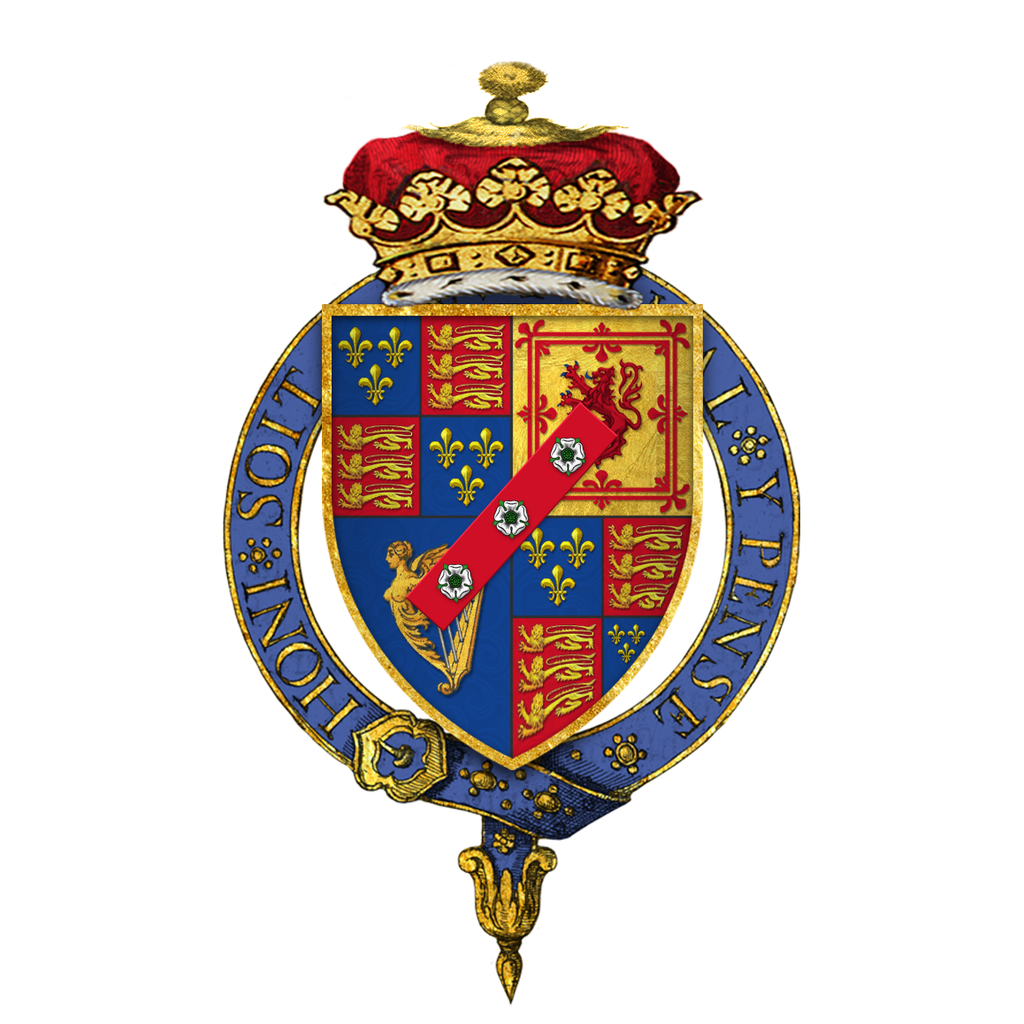
Charles Beauclerk, 1st Duke of St Albans, (8th May 1670 – 10th May 1726) was an illegitimate son of King Charles II of England by his mistress Nell Gwynne.
On 21st December 1676, a warrant was passed for "a grant to Charles Beauclerc, the King's natural son, and to the heirs male of his body, of the dignities of Baron of Heddington, co. Oxford, and Earl of Burford in the same county, with remainder to his brother, James Beauclerk, and the heirs male of his body." A few weeks later, James was given "the title of Lord Beauclerk, with the place and precedence of the eldest son of an earl."
Several legends describe how Charles Beauclerk became Earl of Burford. The first is that on arrival of the King, his mother said, "Come here, you little bastard, and greet your father." When the king rebuked her for calling him that, she replied, "Your Majesty has given me no other name to call him by." In response, Charles created him Earl of Burford.
Another legend is that Beauclerk's mother held him out of a window (or above a river) and threatened to drop him unless he was given a peerage. Charles supposedly cried out "God save the Earl of Burford!" and subsequently created that peerage.
Just after the death of Henry Jermyn, 1st Earl of St Albans at the turn of the year, on 5 January 1684, King Charles granted his son Charles, Earl of Burford, the title of Duke of St Albans, gave him an allowance of £1,000 a year, and granted him the offices of Chief Ranger of Enfield Chace and Master of the Hawks in reversion (i. e. after the death of the current incumbents). He became colonel in the 8th regiment of horse in 1687, and served with the emperor Leopold I, being present at the siege of Belgrade in 1688.
He married Lady Diana De Vere, eldest daughter and co-heir to the twentieth and last Earl of Oxford.
When his mother died (14th November 1687), Beauclerk received a large estate, including Burford House, near Windsor Castle. After the Battle of Landen in 1693, William III made Beauclerk captain of the gentlemen pensioners and four years later gentleman of the bedchamber. His father had given him the reversion of the office of Hereditary Master Falconer and that of Hereditary Registrar of the Court of Chancery, which fell vacant in 1698. His Whig sentiments prevented his advancement under Queen Anne, but he was restored to favour at the accession of King George I. In 1718, George made him a Knight of the Garter.
Beauclerk died at Bath two days after his 56th birthday and is buried in Westminster Abbey. He was succeeded by his eldest son.
Charles Beauclerk was assigned the Royal Arms of his Father King Charles II with a red Baton Sinister charged with three white Roses. Over all was an Inescutcheon, quarterly gules (red) and or (yellow/gold), in the first Quarter a Mullet (six-pointed Star) argent (white/silver) for De Vere. His Crest and Supporters were as follows:
On 21st December 1676, a warrant was passed for "a grant to Charles Beauclerc, the King's natural son, and to the heirs male of his body, of the dignities of Baron of Heddington, co. Oxford, and Earl of Burford in the same county, with remainder to his brother, James Beauclerk, and the heirs male of his body." A few weeks later, James was given "the title of Lord Beauclerk, with the place and precedence of the eldest son of an earl."
Several legends describe how Charles Beauclerk became Earl of Burford. The first is that on arrival of the King, his mother said, "Come here, you little bastard, and greet your father." When the king rebuked her for calling him that, she replied, "Your Majesty has given me no other name to call him by." In response, Charles created him Earl of Burford.
Another legend is that Beauclerk's mother held him out of a window (or above a river) and threatened to drop him unless he was given a peerage. Charles supposedly cried out "God save the Earl of Burford!" and subsequently created that peerage.
Just after the death of Henry Jermyn, 1st Earl of St Albans at the turn of the year, on 5 January 1684, King Charles granted his son Charles, Earl of Burford, the title of Duke of St Albans, gave him an allowance of £1,000 a year, and granted him the offices of Chief Ranger of Enfield Chace and Master of the Hawks in reversion (i. e. after the death of the current incumbents). He became colonel in the 8th regiment of horse in 1687, and served with the emperor Leopold I, being present at the siege of Belgrade in 1688.
He married Lady Diana De Vere, eldest daughter and co-heir to the twentieth and last Earl of Oxford.
When his mother died (14th November 1687), Beauclerk received a large estate, including Burford House, near Windsor Castle. After the Battle of Landen in 1693, William III made Beauclerk captain of the gentlemen pensioners and four years later gentleman of the bedchamber. His father had given him the reversion of the office of Hereditary Master Falconer and that of Hereditary Registrar of the Court of Chancery, which fell vacant in 1698. His Whig sentiments prevented his advancement under Queen Anne, but he was restored to favour at the accession of King George I. In 1718, George made him a Knight of the Garter.
Beauclerk died at Bath two days after his 56th birthday and is buried in Westminster Abbey. He was succeeded by his eldest son.
Charles Beauclerk was assigned the Royal Arms of his Father King Charles II with a red Baton Sinister charged with three white Roses. Over all was an Inescutcheon, quarterly gules (red) and or (yellow/gold), in the first Quarter a Mullet (six-pointed Star) argent (white/silver) for De Vere. His Crest and Supporters were as follows:
Crest: On a Chapeau gules turned up ermine, a Lion statant guardant or, ducally crowned per Pale argent and gules, gorged with a Collar gules charged with three Roses argent barbed nad seeded proper.
Supporters: Dexter, an Antelope argent, attired and unguled or; Sinister, a Greyhound argent, both gorged with a Collar as in the Crest.
James, Lord Beauclerk (1671–1680). He died of "a sore leg"...
By Louise de Kérouaille, Duchess of Portsmouth (1649–1734)
Charles Lennox, 1st Duke of Richmond and Lennox (1672–1723)
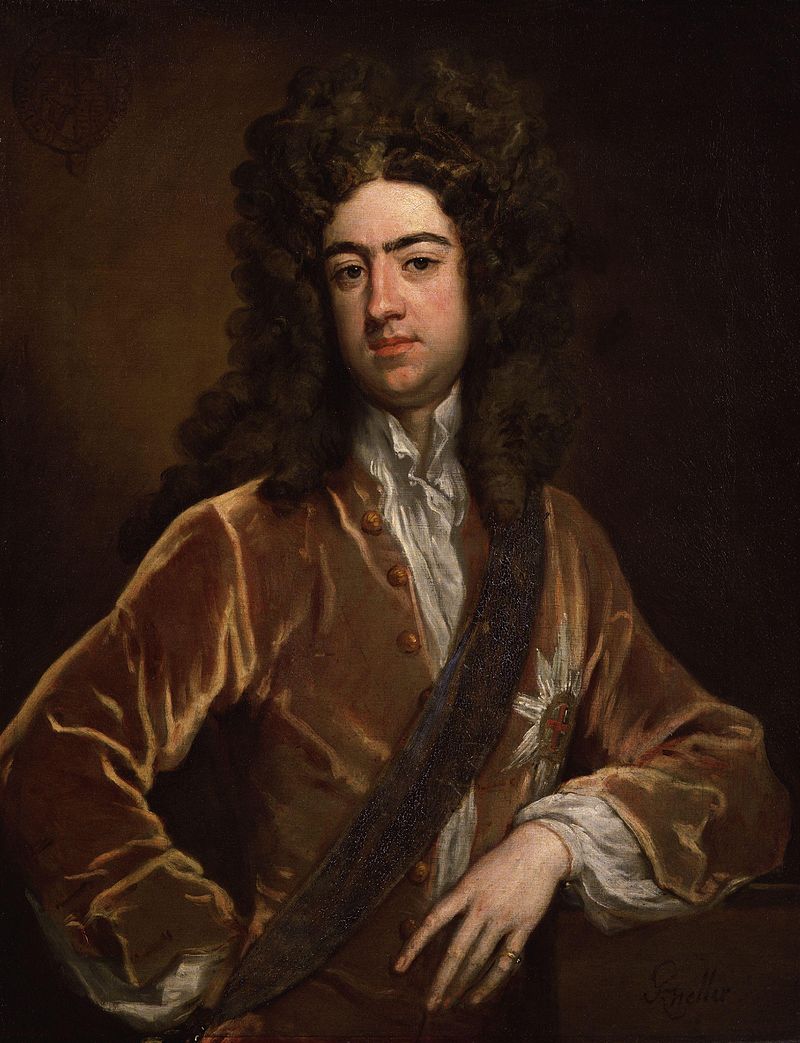
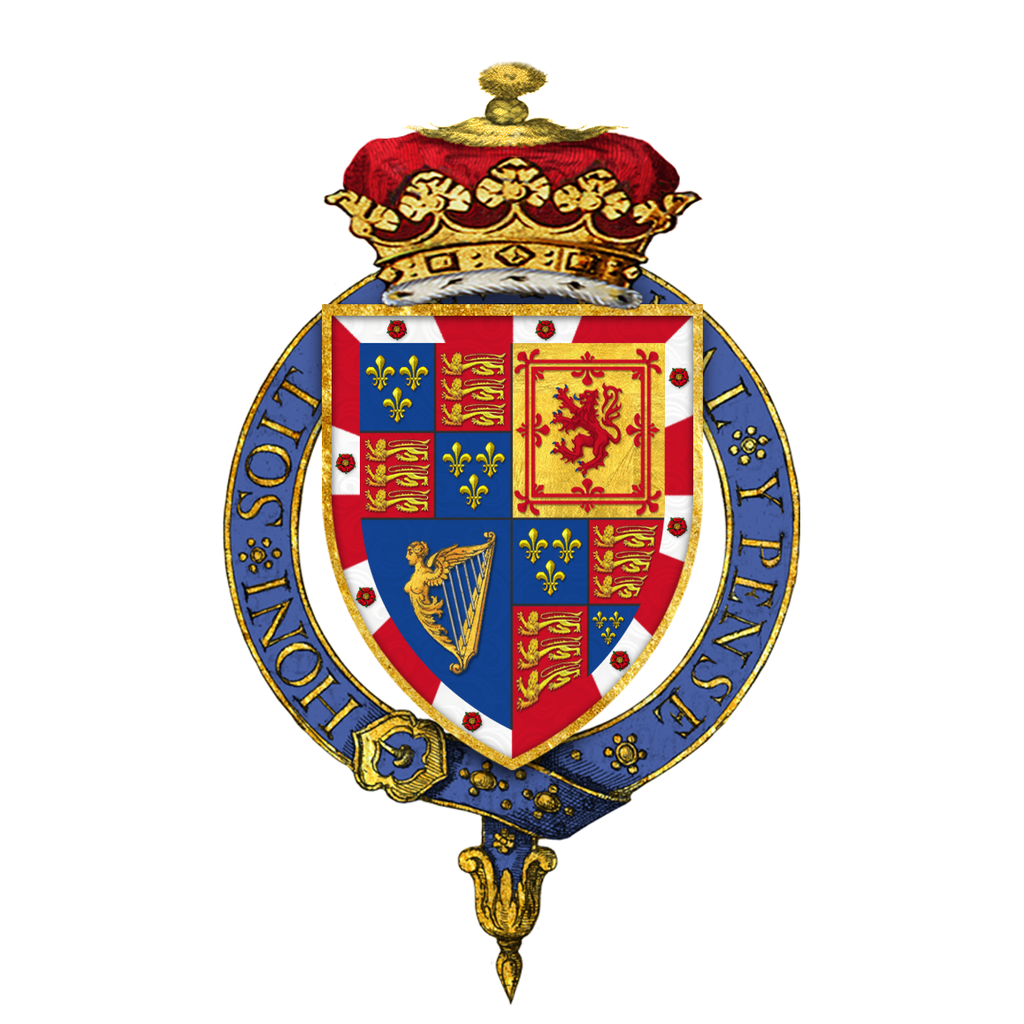
Charles Lennox, 1st Duke of Richmond, 1st Duke of Lennox, 1st Duke of Aubigny (29th July 1672 – 27th May 1723) was an illegitimate son of King Charles II by his mistress Louise de Kérouaille, Duchess of Portsmouth.
Lennox was created Duke of Richmond, Earl of March and Baron Settrington in the Peerage of England on 9th August 1675 and Duke of Lennox, Earl of Darnley and Baron Methuen of Torbolten in the Peerage of Scotland on 9th September 1675, and was invested as a Knight of the Garter on 18th April 1681. He was appointed Lord High Admiral of Scotland, under reservation of the commission granted to James, Duke of Albany and York (later James VII), as Lord High Admiral for life. The appointment was therefore only effective between 1701 and 1705, when Lennox resigned all his Scottish lands and offices.
On 8th January 1692 he married Anne Brudenell (died 9th December 1722), daughter of Francis, Baron Brudenell; they had three children. Lennox himself had an illegitimate child by his mistress Jacqueline de Mézières, Renée Lennox (1709–1774) who, in turn, was the mistress of her cousin Charles Beauclerk, 2nd Duke of St Albans.
Lennox was an early patron of cricket, becoming a leading professional sport, and did much to develop it in Sussex. It is almost certain that he was involved with the earliest known "great match", which took place in the 1697 season and was the first to be reported by the press. The report was in the Foreign Post dated Wednesday, 7 July 1697
Lennox was created Duke of Richmond, Earl of March and Baron Settrington in the Peerage of England on 9th August 1675 and Duke of Lennox, Earl of Darnley and Baron Methuen of Torbolten in the Peerage of Scotland on 9th September 1675, and was invested as a Knight of the Garter on 18th April 1681. He was appointed Lord High Admiral of Scotland, under reservation of the commission granted to James, Duke of Albany and York (later James VII), as Lord High Admiral for life. The appointment was therefore only effective between 1701 and 1705, when Lennox resigned all his Scottish lands and offices.
On 8th January 1692 he married Anne Brudenell (died 9th December 1722), daughter of Francis, Baron Brudenell; they had three children. Lennox himself had an illegitimate child by his mistress Jacqueline de Mézières, Renée Lennox (1709–1774) who, in turn, was the mistress of her cousin Charles Beauclerk, 2nd Duke of St Albans.
Lennox was an early patron of cricket, becoming a leading professional sport, and did much to develop it in Sussex. It is almost certain that he was involved with the earliest known "great match", which took place in the 1697 season and was the first to be reported by the press. The report was in the Foreign Post dated Wednesday, 7 July 1697
"The middle of last week a great match at cricket was played in Sussex; there were eleven of a side, and they played for fifty guineas apiece".
The stakes on offer confirm the importance of the fixture and the fact that it was eleven-a-side suggests that two strong and well-balanced teams were assembled. No other details were given but the report provides real evidence to support the view that top-class cricket, played for high stakes, was in vogue at the time. It was possibly an inter-county match. Lennox sponsored a team in the 1702 season against an Arundel side. His son Charles, the 2nd Duke, inherited his interest in cricket and became the patron of both Sussex county cricket teams and Slindon Cricket Club.
Charles Lennox was assigned the Royal Arms of his Father King Charles II with a Bordure compony of white with red Roses and red. Richmond and Lennox's Crest and Supporters were as follows:
Charles Lennox was assigned the Royal Arms of his Father King Charles II with a Bordure compony of white with red Roses and red. Richmond and Lennox's Crest and Supporters were as follows:
Crest: On a Chapeau gules turned up eermine, a Lion statant guardant or, ducally crowned gules, collared as the Bordure of the Shield.
Supporters: Dexter, a Unicorn argent; Sinister, an Antelope argent, each gorged with a Collar as the Bordure of the Shield.
By Moll Davis, courtesan and actress of repute
Lady Mary Tudor (1673–1726)
| Lady Mary Tudor (16th October 1673 – 5th November 1726) was an actress and natural daughter of King Charles II of England by his mistress, Mary "Moll" Davies, an actress and singer. She is not to be confused with Lady Mary Tudor who would become Queen Mary I. On 18th August 1687, Lady Mary married Edward Radclyffe, 2nd Earl of Derwentwater (9th December 1655 – 29th April 1705) by whom she had four children. Mary separated from Lord Derwentwater in 1700, reportedly due to her unwillingness to convert to Roman Catholicism. On 23rd May 1705, she married secondly, to Henry Graham. This wedding came less than a month after the death of her first husband. It was later reported that the two had been living together before Derwentwater's death. The marriage caused Graham great trouble, both with his family and with others. Before it, Graham had held an office in the household of Prince George of Denmark, the husband of Queen Anne, but as a result of the wedding he was dismissed from it. On 26th August 1707, after Graham's death, on 7th January 1707, Mary married thirdly, to Major James Rooke. Lady Mary died in Paris on 5 November 1726, aged 53. | 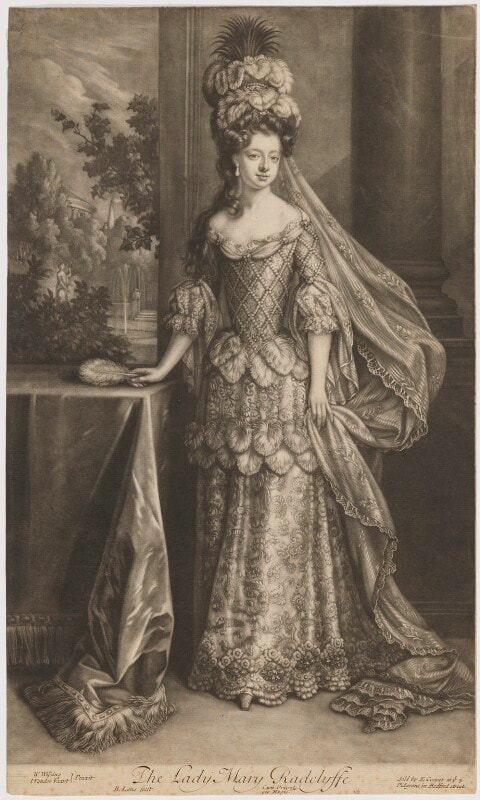 Mary Radcliffe (née Tudor), Countess of Derwentwater by Bernard Lens (II), after Jan van der Vaart, after Willem Wissing, published by Edward Cooper. Mezzotint, circa 1687-1696. Source: National Portrait Gallery: NPG D35147. |
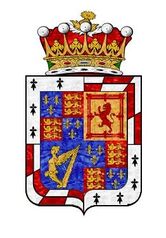 Alleged Coat of Arms of Lady Mary Tudor. Source: http://www.europeanheraldry.org | These are the alleged Coat of Arms of Lady Mary Tudor and show the Royal Arms of her Father King Charles II with a Bordure quarterly I and IV ermine and II and III countercompony (i.e., two rows of squares in white and red.) They are mentioned in The Royal Heraldry of England by J. H. & R. V. Pinches, 1974. Unfortunately the Arms are represented here on a Shield rather than on a Lozenge and are ensigned with a Earl's Coronet which presumably refers to Lady Mary's first husband. |
James II and VII
James II and VII had 13 illegitimate children.
By Arabella Churchill (1648–1730)
Henrietta FitzJames, (1667 – 3rd April 1730). According to The Royal Heraldry of England by J. H. & R. V. Pinches, 1974, Henrietta was granted the Royal Arms with a Baton sinister charged with Fleurs-de-Lys.
James FitzJames, 1st Duke of Berwick, (1670–1734)
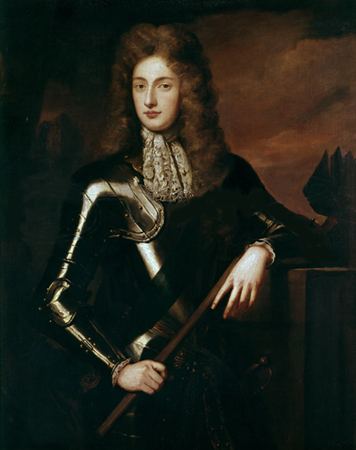

James FitzJames (21st August 1670 – 12th June 1734) was a natural son of James, Duke of York, by Arabella Churchill, sister of the future Duke of Marlborough. He spent almost all his life abroad in foreign military service.
Born and educated in France, Berwick volunteered to join the emperor's forces besieging the Turkish redoubt of Buda in 1686. His father's succession as James II suggested a great career in Britain. He was created duke in 1687, made governor of Portsmouth (a post of responsibility in troubled times), and awarded the Garter. But James's flight in 1688 condemned Berwick to a life of distinguished exile. He fought for his father in Ireland and then settled down in France, being naturalized in 1702 and created a marshal of France in 1706.
Sent to Spain to restore the flagging fortunes of Philip V, he won a great victory at Almanza in 1707. He was given French and Spanish dukedoms, which still survive in the family.
The last great event of the War of the Spanish Succession was the Duke of Berwick's storming of Barcelona, after a long siege, on 11 September 1714. In that year, he was appointed a Knight of the Golden Fleece. Trying to explain the violent failure of the Jacobite Risings, the Old Pretender "never forgave his half-brother, The Blues ex-colonel, Berwick, now an experienced and competent commander, for declining to lead his forces". Soon afterwards, Berwick was appointed military governor of the province of Guienne, where he became friendly with Montesquieu, a French judge, man of letters, and political philosopher. In December 1718 he led an army to Spain, against Philip V, in the War of the Quadruple Alliance, bombarding San Sebastián and occupying the districts of Gipuzkoa and Biscay. Many years of peace followed this campaign that ended the following March. The King of Spain sued for peace in January 1720 and Berwick was not called to serve again in the field until 1733. In that year he was chosen to lead the Army of the Rhine in the War of the Polish Succession, successfully besieging Kehl.
In 1734, at the age of 64, still fighting for his adopted country in the War of the Polish Succession, he was killed outside Philipburg by a stray cannon-ball. His reputation was as a brave soldier and a sensible adviser. Montesquieu wrote of him that ‘he was brought up to support a sinking cause’.
Berwick had children by both his marriages. His descendants were the French Ducs de Fitz-James and the Spanish Duques de Liria and later the Dukes of Alba.
As can be seen above, James was granted the Royal Arms within a Bordure compony of England and France, namely red with a gold Lion and blue with a gold Fleur-de-Lys. I cannot find corroboration for his Crest and Supporters but they appear to be as follows:
Born and educated in France, Berwick volunteered to join the emperor's forces besieging the Turkish redoubt of Buda in 1686. His father's succession as James II suggested a great career in Britain. He was created duke in 1687, made governor of Portsmouth (a post of responsibility in troubled times), and awarded the Garter. But James's flight in 1688 condemned Berwick to a life of distinguished exile. He fought for his father in Ireland and then settled down in France, being naturalized in 1702 and created a marshal of France in 1706.
Sent to Spain to restore the flagging fortunes of Philip V, he won a great victory at Almanza in 1707. He was given French and Spanish dukedoms, which still survive in the family.
The last great event of the War of the Spanish Succession was the Duke of Berwick's storming of Barcelona, after a long siege, on 11 September 1714. In that year, he was appointed a Knight of the Golden Fleece. Trying to explain the violent failure of the Jacobite Risings, the Old Pretender "never forgave his half-brother, The Blues ex-colonel, Berwick, now an experienced and competent commander, for declining to lead his forces". Soon afterwards, Berwick was appointed military governor of the province of Guienne, where he became friendly with Montesquieu, a French judge, man of letters, and political philosopher. In December 1718 he led an army to Spain, against Philip V, in the War of the Quadruple Alliance, bombarding San Sebastián and occupying the districts of Gipuzkoa and Biscay. Many years of peace followed this campaign that ended the following March. The King of Spain sued for peace in January 1720 and Berwick was not called to serve again in the field until 1733. In that year he was chosen to lead the Army of the Rhine in the War of the Polish Succession, successfully besieging Kehl.
In 1734, at the age of 64, still fighting for his adopted country in the War of the Polish Succession, he was killed outside Philipburg by a stray cannon-ball. His reputation was as a brave soldier and a sensible adviser. Montesquieu wrote of him that ‘he was brought up to support a sinking cause’.
Berwick had children by both his marriages. His descendants were the French Ducs de Fitz-James and the Spanish Duques de Liria and later the Dukes of Alba.
As can be seen above, James was granted the Royal Arms within a Bordure compony of England and France, namely red with a gold Lion and blue with a gold Fleur-de-Lys. I cannot find corroboration for his Crest and Supporters but they appear to be as follows:
Crest: A Dragon passant argent, gorged with a Collar azure charged with three Fleurs-de-Lys or.
Supporters: Dexter, a Unicorn argent armed, unguled and crined or, gorged with a Collar as in the Crest, attached thereto a Chain reflexed over the back azure. Sinister, a Dragon gules collared and chained as the dexter Supporter.
Henry FitzJames, 1st Duke of Albemarle, (1673–1702)
| Henry FitzJames (6th August 1673 – 16th December 1702), titular 1st Duke of Albemarle in the Jacobite peerage, was the illegitimate son of King James II of England (and VII of Scotland) by Arabella Churchill, sister of the first Duke of Marlborough. FitzJames was born in St. James's Square, Westminster, then in the county of Middlesex, England. He was the brother of James FitzJames, 1st Duke of Berwick, the French Marshal. On 20th July 1700, he married Marie Gabrielle d'Audibert de Lussan, daughter and heiress of Jean d'Audibert, Comte de Lussan. He had a posthumous daughter, Lady Christine Marie Jacqueline Henriette FitzJames, born 29th May 1703 at Bagnols sur Cèze, Languedoc, France, who became a nun. His widow remarried in May 1707, at Saint-Germain-en-Laye, to John Drummond, Marquess of Forth, later 2nd Duke of Melfort (1682–1754). | 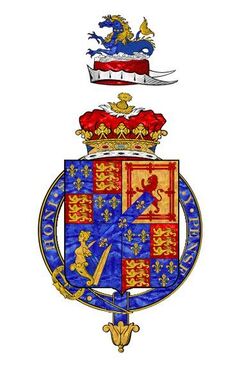 Coat of Arms of Henry FitzJames, (1673-1702) 1st Duke of Albemarle. Source: www.europeanheraldry.org |
FitzJames was created Duke of Albemarle, together with the subsidiary titles of Earl of Rochford and Baron Romney, by his father on 13th January 1696, but the title is only recognized by Jacobites. He was also appointed the Grand Prior of the revived Priory of the English Commandery of the Sovereign Military Order of St. John of Jerusalem, Rhodes and Malta, known as the Knights of Malta.
Henry was granted, by Royal Warrant in 1686, the Royal Arms, debruised by a Baton sinister azure charged with threee Fleurs-de-Lys or. His Crest was as follows:
Henry was granted, by Royal Warrant in 1686, the Royal Arms, debruised by a Baton sinister azure charged with threee Fleurs-de-Lys or. His Crest was as follows:
On a Chapeau gules turned up ermine, a Sea Horse proper, gorged with a Collar azure charged with three Fleurs-de-Lys or.
Arabella FitzJames, (1674 – 7th November 1704), became a nun.
By Catherine Sedley, Countess of Dorchester (1657-1717)
Catherine Darnley c. 1681-13 March 1743. Alleged daughter. Married firstly, James Annesley, 3rd Earl of Anglesey and had issue. Married secondly, John Sheffield, 1st Duke of Buckingham and Normanby and had issue. Shortly before her Father was deposed, she was granted the following Arms:
Shield: The Royal Arms within a Bordure compny ermine and azure, the azure charged with Fleus-de-Lys or.
Supporters: Dexter, a Unicorn ermine, armed, unglued and crined or, gorged with a Chaplet of red Roses seeded or leaved proper. Sinister, a Goat ermine, armed and unguled azure, gorged with a similar collar.
There is evidence that her husbands made use of these Arms.
James Darnley 1684-22nd April 1685.
Charles Darnley. Died young.
James Darnley 1684-22nd April 1685.
Charles Darnley. Died young.
George I
Melusine von der Schulenburg, Duchess of Kendal (1667-1743)
Anna Luise Sophie von der Schulenburg, Countess of Dölitz (1692–1773), who married Ernest August Philipp von dem Bussche zu Ippenburg.
Petronilla Melusina von der Schulenburg (1693–1778), who married Philip Stanhope, 4th Earl of Chesterfield, a leading Whig politician.
Margarethe Gertrud von Oeynhausen (1701–1726), who married Albrecht Wolfgang, Count of Schaumburg-Lippe.
Petronilla Melusina von der Schulenburg (1693–1778), who married Philip Stanhope, 4th Earl of Chesterfield, a leading Whig politician.
Margarethe Gertrud von Oeynhausen (1701–1726), who married Albrecht Wolfgang, Count of Schaumburg-Lippe.
William IV
By Dorothea Jordan (1761-1816) 'Mrs Jordan'
George FitzClarence, Earl of Munster (1794-1842)
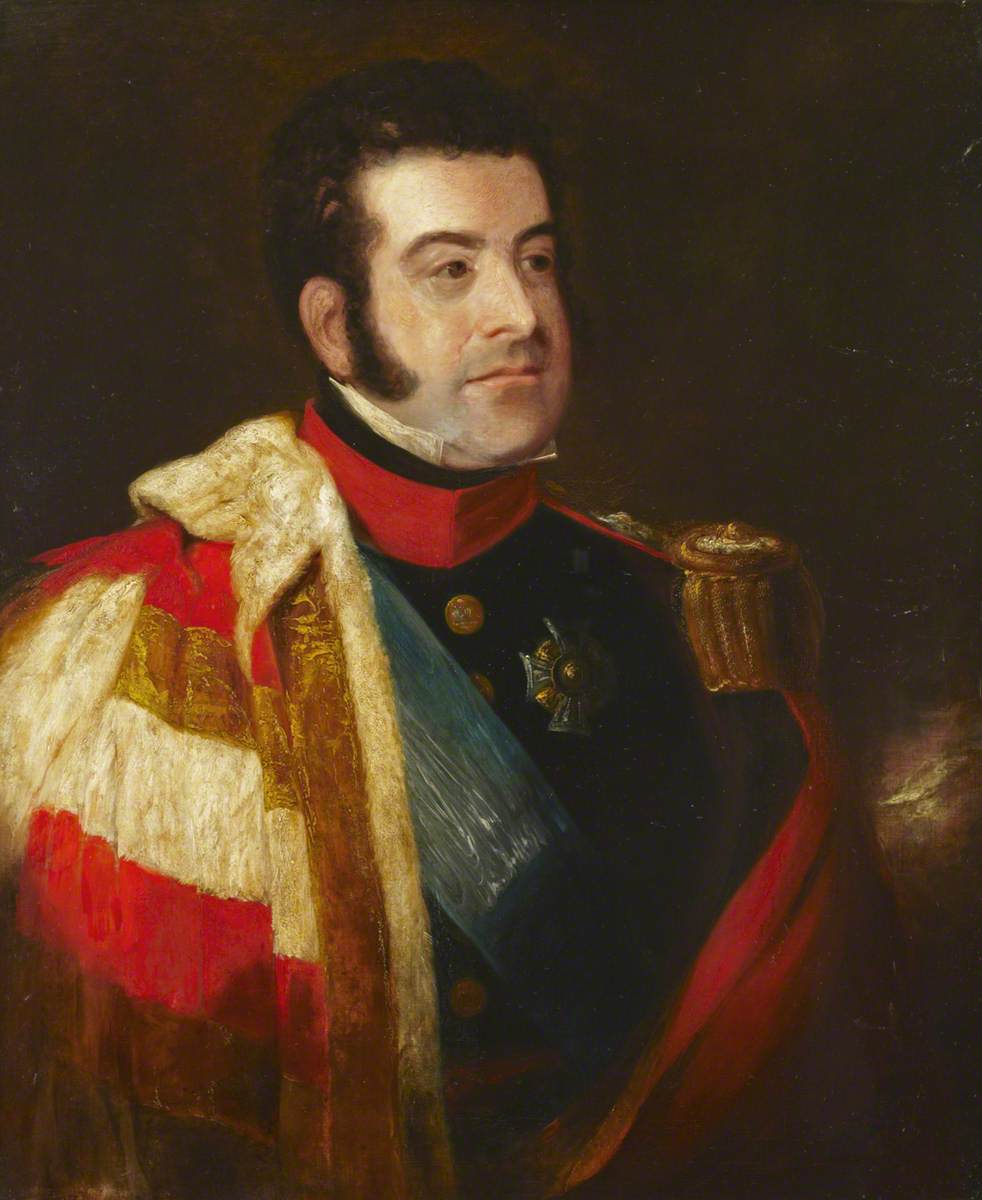
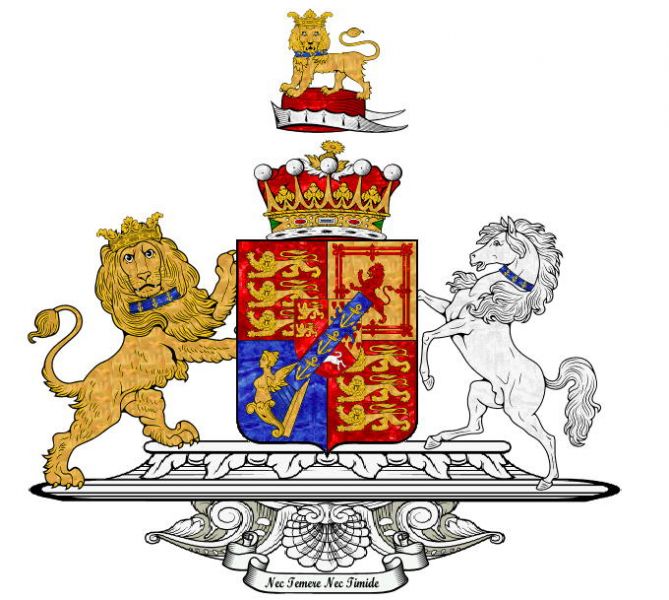
George Augustus Frederick FitzClarence, 1st Earl of Munster (29th January 1794 – 20th March 1842) was the eldest illegitimate son of William IV of the United Kingdom and his long-time mistress Dorothea Jordan. He was well-educated, although his written English was atrocious (as was that of several of his royal uncles). Like his siblings, he had little contact with his mother after his parents separated in 1811, preferring to rely on his expectations from his father.
He served as an army officer during the Peninsular War and subsequently in India. His father, though proud of his military record, was deeply concerned about his drinking and gambling, vices to which many of William's brothers were prone.He was created 1st Earl of Munster, 1st Viscount FitzClarence and 1st Baron Tewkesbury on 4th June 1831, and made a Privy Councillor in 1833. "Earl of Munster" had been a title held by his father before his accession to the British throne.
George, like his siblings, was dissatisfied with the provisions made for him and this, combined with his increasing mental instability, caused a series of quarrels with his father which ended in a complete breach. The estrangement caused the King great distress, but those close to him thought it better that there be as little contact as possible, since Munster's visits invariably upset his father. Even the death of Munster's sister Sophia de L'Isle, the King's favourite child, in April 1837, did not bring about a reconciliation.
He gained the rank of Major-General in the British Army and held the office of aide-de-Camp to his father King William IV between 1830 and 1837. He held the office of Lieutenant of the Tower of London between 1831 and 1833, was Constable and Governor of Windsor Castle between 1833 and 1842 and aide-de-Camp to Queen Victoria between 1837 and 1841. He was elected president of the Royal Asiatic Society in 1841.
FitzClarence committed suicide at the age of 48 in London. He shot himself with a pistol presented to him by King George IV when Prince of Wales. His suicide came as no surprise to his family who had long been concerned about his mental condition; his father's biographer attributes it to "a paranoiac sense of persecution." At his inquest, his doctor and a surgeon told the coroner that they believed he was going mad, and in recent years there has been speculation that he suffered from the probably hereditary malady of porphyria which had afflicted his grandfather and several other members of the family.
George Augustus was granted the following Coat of Arms once his Father came to the Throne:
He served as an army officer during the Peninsular War and subsequently in India. His father, though proud of his military record, was deeply concerned about his drinking and gambling, vices to which many of William's brothers were prone.He was created 1st Earl of Munster, 1st Viscount FitzClarence and 1st Baron Tewkesbury on 4th June 1831, and made a Privy Councillor in 1833. "Earl of Munster" had been a title held by his father before his accession to the British throne.
George, like his siblings, was dissatisfied with the provisions made for him and this, combined with his increasing mental instability, caused a series of quarrels with his father which ended in a complete breach. The estrangement caused the King great distress, but those close to him thought it better that there be as little contact as possible, since Munster's visits invariably upset his father. Even the death of Munster's sister Sophia de L'Isle, the King's favourite child, in April 1837, did not bring about a reconciliation.
He gained the rank of Major-General in the British Army and held the office of aide-de-Camp to his father King William IV between 1830 and 1837. He held the office of Lieutenant of the Tower of London between 1831 and 1833, was Constable and Governor of Windsor Castle between 1833 and 1842 and aide-de-Camp to Queen Victoria between 1837 and 1841. He was elected president of the Royal Asiatic Society in 1841.
FitzClarence committed suicide at the age of 48 in London. He shot himself with a pistol presented to him by King George IV when Prince of Wales. His suicide came as no surprise to his family who had long been concerned about his mental condition; his father's biographer attributes it to "a paranoiac sense of persecution." At his inquest, his doctor and a surgeon told the coroner that they believed he was going mad, and in recent years there has been speculation that he suffered from the probably hereditary malady of porphyria which had afflicted his grandfather and several other members of the family.
George Augustus was granted the following Coat of Arms once his Father came to the Throne:
Shield: The Royal Arms of King William IV, without the Electoral Inescutcheon and the Crown of Hanover, debruised by a Baston sinister azure, charged with three Anchors or.
Crest: On a Chapeua gules upturned ermine, a Lion statant guardant, ducally crowned or and gorged with a Collar azure charge with three Anchors gold.
Supporters: Dexter, a Lion guardant, ducally crowned or. Sinister, a Horse argent; each gorged with a similar Collar to the Crest.
You will notice the pattern started by King Charles II and his illegitimate children.
Henry Edward FitzClarence (27th March 1795 – September 1817). No issue.
Sophia FitzClarence (August 1796 – 10th April 1837), married Philip Sidney, 1st Baron De L'Isle and Dudley.
Mary FitzClarence (19th December 1798 – 13th July 1864), married General Charles Richard Fox. No issue.
Henry Edward FitzClarence (27th March 1795 – September 1817). No issue.
Sophia FitzClarence (August 1796 – 10th April 1837), married Philip Sidney, 1st Baron De L'Isle and Dudley.
Mary FitzClarence (19th December 1798 – 13th July 1864), married General Charles Richard Fox. No issue.
Lord Frederick FitzClarence (1799-1854)

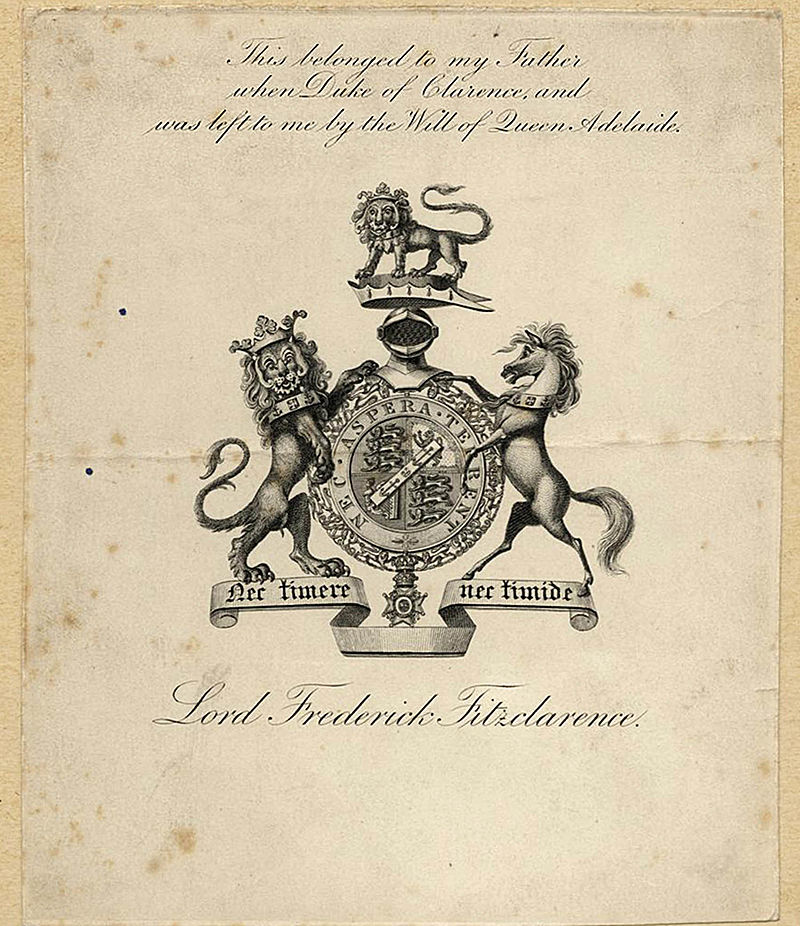
Lieutenant-General Lord Frederick FitzClarence (9th December 1799 – 30th October 1854) was a British Army officer as well as being the illegitimate third son of King William IV and his mistress, Dorothea Jordan.
FitzClarence was commissioned as an officer in the British Army in 1814. While a captain in the Coldstream Guards, FitzClarence commanded a small detachment of Guards to act in support of the police with the arrest of the Cato Street conspirators in 1820. The arrest was not straightforward, and a scuffle ensued.
Frederick FitzClarence gained the rank of Colonel in the service of the 36th (Herefordshire) Regiment of Foot. On 24th May 1831 he was granted the rank of a marquess' younger son. Having been invested as a Knight Grand Cross of the Royal Guelphic Order that same year, he became Lieutenant-Governor of Portsmouth and General Officer Commanding South-West District in 1847 and then Commander-in-Chief of the Bombay Army in 1852. He died in office in October 1854.
On 19th May 1821, he married Lady Augusta Boyle (d. 28th July 1876), the eldest daughter of the 4th Earl of Glasgow. They had two children: Augusta and William.
As can be seen from the bookplate, there is evidence that Frederick was granted Arms, as, apparently, were all his brothers. However, I can find no evidence of what those further Arms were. Secondly, the illustration of Frederick's bookplate is annoyingly insufficient to make out what the Charge on the Baston between the two Anchors actually is further than a Shield with some kind of Cross on it. Obviously, if anyone has a record of what Arms were granted to William IV's illegitimate sons were, I would be very grateful.
FitzClarence was commissioned as an officer in the British Army in 1814. While a captain in the Coldstream Guards, FitzClarence commanded a small detachment of Guards to act in support of the police with the arrest of the Cato Street conspirators in 1820. The arrest was not straightforward, and a scuffle ensued.
Frederick FitzClarence gained the rank of Colonel in the service of the 36th (Herefordshire) Regiment of Foot. On 24th May 1831 he was granted the rank of a marquess' younger son. Having been invested as a Knight Grand Cross of the Royal Guelphic Order that same year, he became Lieutenant-Governor of Portsmouth and General Officer Commanding South-West District in 1847 and then Commander-in-Chief of the Bombay Army in 1852. He died in office in October 1854.
On 19th May 1821, he married Lady Augusta Boyle (d. 28th July 1876), the eldest daughter of the 4th Earl of Glasgow. They had two children: Augusta and William.
As can be seen from the bookplate, there is evidence that Frederick was granted Arms, as, apparently, were all his brothers. However, I can find no evidence of what those further Arms were. Secondly, the illustration of Frederick's bookplate is annoyingly insufficient to make out what the Charge on the Baston between the two Anchors actually is further than a Shield with some kind of Cross on it. Obviously, if anyone has a record of what Arms were granted to William IV's illegitimate sons were, I would be very grateful.
Elizabeth FitzClarence (17th January 1801 – 16th January 1856), married William Hay, 18th Earl of Erroll.
Rear-Admiral Lord Adolphus FitzClarence GCH, ADC, RN (18th February 1802 – 17th May 1856). No issue.
Augusta FitzClarence (17th November 1803 – 8th December 1865) married, firstly, Hon. John Kennedy-Erskine, 5th July 1827, married secondly, Admiral Lord Frederick Gordon-Hallyburton.
Lord Augustus FitzClarence (1st March 1805 – 14th June 1854), rector at Mapledurham in Oxfordshire.
Amelia FitzClarence (21st March 1807 – 2nd July 1858), married Lucius Bentinck Cary, 10th Viscount Falkland.
Rear-Admiral Lord Adolphus FitzClarence GCH, ADC, RN (18th February 1802 – 17th May 1856). No issue.
Augusta FitzClarence (17th November 1803 – 8th December 1865) married, firstly, Hon. John Kennedy-Erskine, 5th July 1827, married secondly, Admiral Lord Frederick Gordon-Hallyburton.
Lord Augustus FitzClarence (1st March 1805 – 14th June 1854), rector at Mapledurham in Oxfordshire.
Amelia FitzClarence (21st March 1807 – 2nd July 1858), married Lucius Bentinck Cary, 10th Viscount Falkland.
Queen Victoria
No, not what you might be thinking...
With the ascension of Queen Victoria to the Throne in 1837 following the death of her Uncle, King William IV, she wanted the profligate lifestyles of her extravagant and self-indulgent uncles and Hanoverian ancestors swept under the carpet. Royal illegitimate children were therefore something not to talk about, let alone brag about. And so this Blog comes to a somewhat natural conclusion.
With the ascension of Queen Victoria to the Throne in 1837 following the death of her Uncle, King William IV, she wanted the profligate lifestyles of her extravagant and self-indulgent uncles and Hanoverian ancestors swept under the carpet. Royal illegitimate children were therefore something not to talk about, let alone brag about. And so this Blog comes to a somewhat natural conclusion.
J. Paul Murdock
All things Royal and Heraldic from the UK and Europe. Starting off with the younger generations and heading back. Mainly sticking to the descendants of Queen Victoria, but throwing in the odd other royal now and again...
Archives
June 2020
May 2020
April 2020
March 2020
February 2020
January 2020
December 2019
November 2019
October 2019
September 2019
August 2019
July 2019
June 2019
May 2019
April 2019
March 2019
February 2019
January 2019
December 2018
November 2018
October 2018
September 2018
August 2018
July 2018
June 2018
May 2018
April 2018
February 2018
January 2018
December 2017
August 2017
July 2017
June 2017
May 2017
May 2016
July 2015
May 2015
April 2015
 RSS Feed
